













AlgoLab opens on 16 November with Q at its center
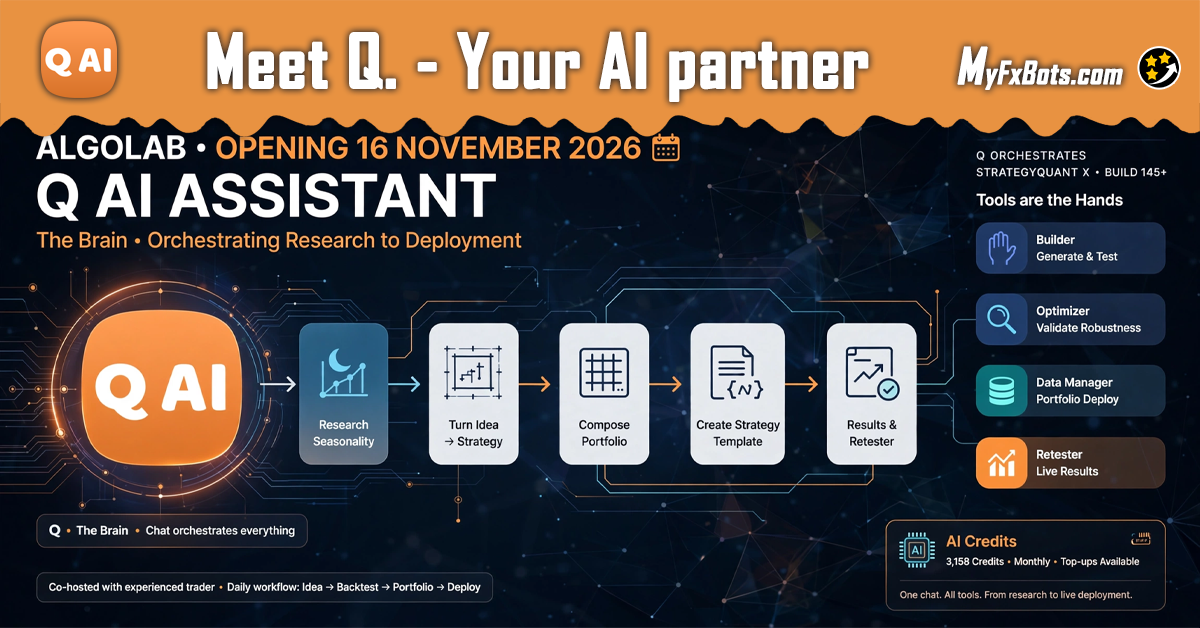
Two vendor emails, dated 14 and 15 November 2026, announce a new AlgoLab round beginning Monday, 16 November 2026. The later message names the co-host: Libor, described as an experienced trader who uses Q AI Assistant daily to orchestrate his research, from finding ideas through testing and deployment. Both messages offer the same free package — the AlgoLab lessons, a StrategyQuant X Lab license and AI credits — and both say the robots a participant builds remain their own. They differ on scarcity: the 14 November email limits free credits to the first few hundred registrations, while the 15 November email says only that credit-bearing spots are limited and may run out soon.
What the assistant actually does
On its product page, the vendor presents Q AI Assistant as one chat that orchestrates all StrategyQuant X tools, from research to deployment. It runs inside StrategyQuant X build 145 or later and requires a StrategyQuant X user account and an internet connection; the vendor says it works on every operating system that the platform supports. The division of labor is stated plainly — Q is the brain, the tools are the hands — and an Artificial Intelligence - AI layer selects the module, the settings, and the workflow once the user describes a task in ordinary language. A session ends with a results report and an Open in Retester option.
How a research conversation runs
The vendor's examples are tasks rather than instruments: research seasonality, turn an idea from a YouTube video into a strategy, compose a portfolio, create a strategy template. The product page also sets Q against general AI coding agents such as Claude Code or Codex, listing what each has to assemble before research can begin.
| Stage | General AI coding agent | Q inside StrategyQuant X |
|---|---|---|
| Research setup | Connect tools, libraries, and workflows | All the tools are already connected |
| Backtesting | Select and integrate a backtester | StrategyQuant X backtester |
| Market data | Find, clean, and prepare data | Broker-adjusted data, ready to use |
| Testing and validation | Build the testing workflow | Integrated robustness and optimization tools |
| Deployment | Build and verify the connection | Validated exports to trading platforms |
The vendor concedes the framing: general agents can be extended with tools and integrations, and the comparison covers only the research environment a user would otherwise have to assemble. It describes what ships connected, not what any strategy returns.
Credits, plans, and what a session costs
Q is paid for in AI credits, kept separate from the StrategyQuant X license. Each request consumes credits, and the vendor states that the exact cost is not fixed because it depends on prompt length, complexity, and the model used.
| Plan | Price per month | Credits per month | Price per 1,000 credits |
|---|---|---|---|
| Basic | $20 | 4,500 | $4.44 |
| Pro | $50 | 12,500 | $4.00 |
| Max | $200 | 60,000 | $3.33 |
Plans renew automatically, top-ups cost $5 per 1,000 credits with or without a plan, and a monthly plan is optional. New licenses arrive with welcome credits: 1,200 on Starter, 2,400 on Professional, 6,000 on Ultimate, 300 once for a trial user, and 500 for existing license holders. Monthly plan credits expire at the end of each billing period, while welcome, purchased, and bonus credits last 12 months. The vendor prices a typical backtest review at 81 credits and applying a Builder configuration at 51.
The evidence and its limits
No independent record accompanies this product: there is no third-party tracking page and no published statement to inspect, so everything above rests on vendor material — two emails and the product, pricing, and terms pages. The vendor's own site carries a hypothetical performance disclosure and states that StrategyQuant X is analysis and strategy-development software, not a broker or investment adviser that executes trades or holds client funds. Two points are worth flagging rather than resolving. The Black Friday license page advertises a doubled AI credit portion (2×1,200, 2×2,400, 2×6,000) while the Q pricing page lists 1,200, 2,400 and 6,000 as the welcome allocation. And the roadmap adding further products in Q4 2026 and 2027 is described by the vendor as indicative.
What to verify before registering
Anyone registering should confirm that their installation is on build 145 or later, because earlier builds do not carry the assistant. They should also establish which credits AlgoLab grants, when those credits expire, and whether the wording they receive matches the first few hundred registrations of 14 November or the looser scarcity of 15 November. On platforms, the two emails differ slightly: the earlier lists MT5 and NinjaTrader together, the later presents them as a choice and adds that the robots target CFDs or futures. Terms worth reading first include the 14-day trial, the one-license-one-computer rule, and the non-refundable fee policy.
The AlgoLab round of 16 November is a dated, free event with a limited credit allocation, and Q itself is a paid service with published credit estimates. Neither the emails nor the product pages report what any user has achieved with it, and the vendor's own disclosure warns that past performance is not indicative of future results. The practical next step is to check the build number, the credit balance, and the expiry date on the account.