













1. Why a Structured Workflow Matters
Successful algo trading is built on repeatable processes. With tools like StrategyQuant X, traders can move beyond random clicking and instead follow a systematic approach that produces stable, testable strategies suitable for long‑term portfolios.
A structured workflow ensures:
Consistent strategy logic
Measurable performance metrics
Reliable robustness testing
Reduced overfitting
Better integration with brokers such as IC Markets
2. Choosing the Right Market
Beginners often achieve the best results by starting with markets that offer clean data and strong liquidity.
Recommended Markets
Major Forex pairs: EURUSD, GBPUSD
Cross pairs: EURJPY, GBPJPY
Metals: XAUUSD (gold), known for strong trends
CFD indices: NASDAQ, S&P 500, Dow Jones
Futures equivalents: High‑liquidity index futures
These markets provide statistically favorable environments for building breakout and trend‑based strategies.
3. Core Metrics Every Trader Should Monitor
When evaluating an algo strategy, focus on metrics that reveal stability and risk efficiency:
Profit Factor: Measures profitability vs. losses
Return/Drawdown Ratio: Shows reward relative to risk
Sharpe Ratio: Evaluates how efficiently volatility is converted into profit
Trade Count: Ensures statistical significance
Win Rate: Helps validate execution quality
These metrics help determine whether a strategy can survive real‑market conditions.
4. Building Your Workflow with AI Templates
AI templates in StrategyQuant X allow traders to automate the strategy‑building process while maintaining control over logic and structure.
Typical Workflow Steps
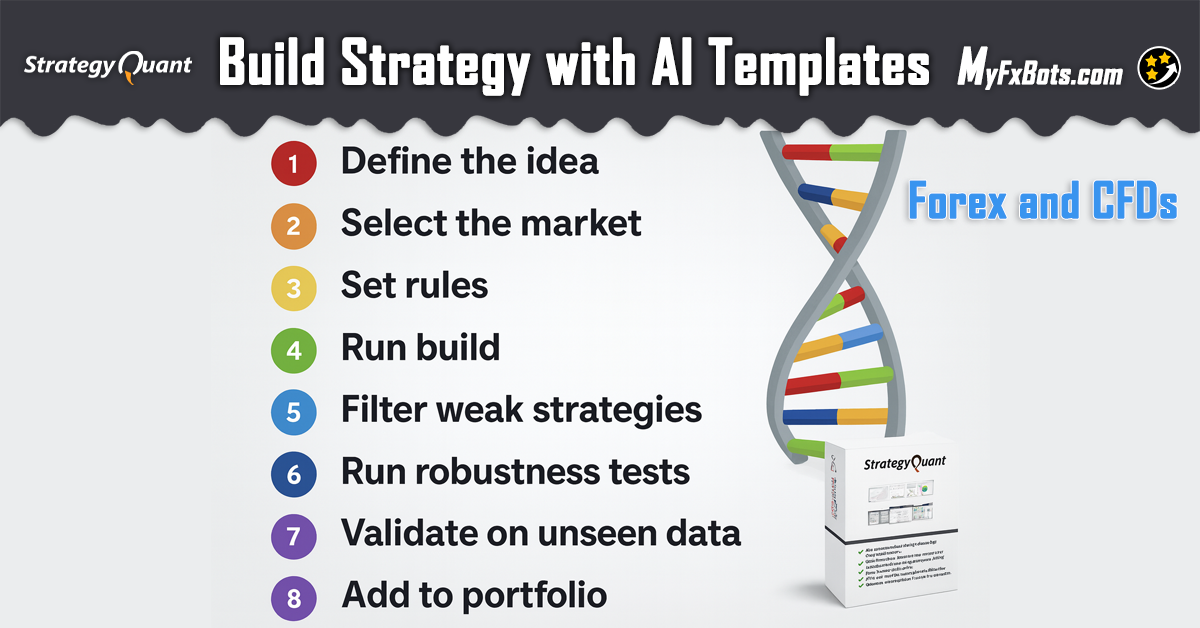
Define the idea
Select the market
Set measurable rules
Run the build
Filter weak strategies
Perform robustness tests
Validate on unseen data
Add to your portfolio
This approach transforms strategy creation into a repeatable, scalable process.
5. Automating Custom Projects
Custom projects allow traders to automate multi‑step workflows.
Key Components
Build settings: Time ranges, in‑sample vs. out‑of‑sample
Entry/exit logic: Long‑only, short‑only, or both
Genetic vs. random generation: Controls how strategies evolve
Indicator limits: Number of conditions and periods
Risk parameters: Stop‑loss, take‑profit, slippage
Cross‑checks: Higher precision backtests, multi‑market tests
Ranking filters: Minimum PF, R/DD, trade count, win rate
This ensures only statistically meaningful strategies survive.
6. Robustness Testing Across Markets and Conditions
A strategy that works only on one dataset is unreliable. Robustness testing helps eliminate fragile systems.
Recommended Tests
Unseen data (2023–present)
Other markets (Dow Jones, S&P 500)
Higher timeframes (H4)
Lower timeframes (M30)
Slippage stress tests
Monte Carlo simulations
Random trade skipping
These tests reveal sensitivity to execution, volatility, and parameter shifts.
7. Running the Build and Saving Your Strategies
Once the workflow is ready:
Start the build
Allow strategies to pass through all filters
Review the final data bank
Save selected strategies in SQX format
Prepare them for further robustness testing or live deployment
This structured approach helps traders build portfolios of durable, diversified strategies.