













Q brings research tools into one workflow
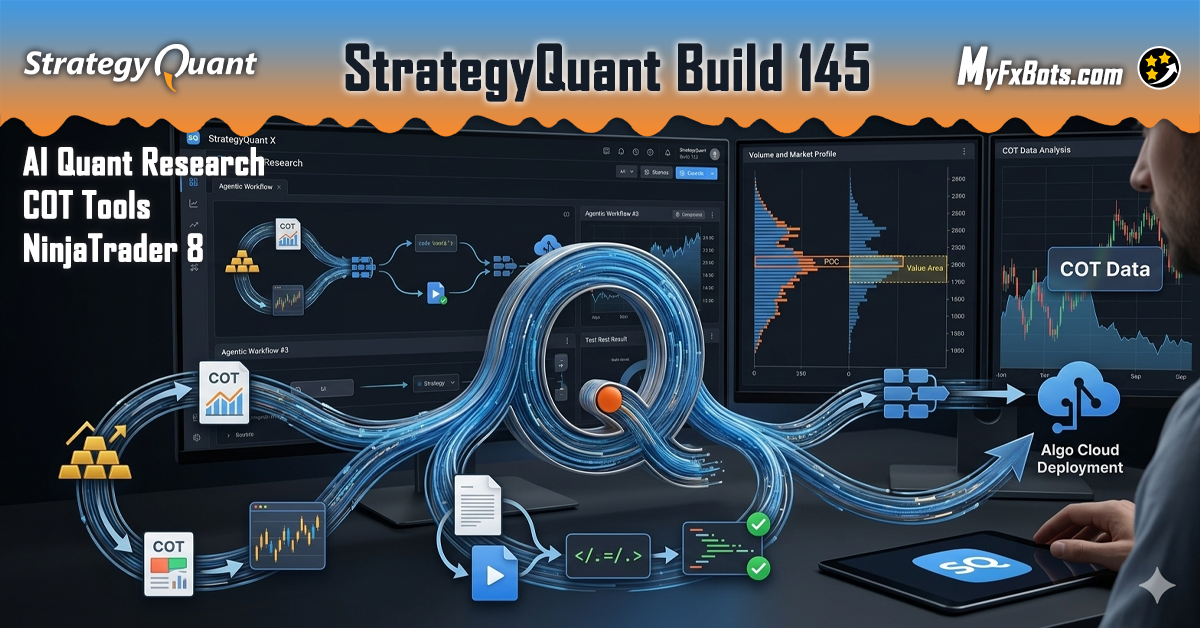
Build 145 introduces Q, which the developer describes as a personal AI agent for quant research. Instead of manually moving among separate tools, users can describe a task in plain language: investigate a possible edge in gold, test a strategy’s robustness, examine COT data, or assess a strategy against prop-firm rules. The announcement says Q can work with the platform’s documentation and across its research tools, Python, AI features and data.
The proposed workflow can begin with research, such as seasonality analysis, then carry an idea into strategy development and the re-tester for robustness checks. Other examples include comparing data feeds, investigating missing or suspicious data, and examining volatility profiles or market regimes. The video also describes Q coding plugins, snippets, signals and indicators, and creating repeated agentic research loops that decide what to investigate next.
These are capabilities described by the developer, not independent performance results. An AI-generated idea or code still needs review: validate assumptions, inspect code, test on suitable data and account for overfitting, execution costs and changing market conditions. Asking Q to analyze a strategy against prop-trading rules does not establish that it will pass an evaluation.
COT and market-profile building blocks
The release adds Commitment of Traders (COT) reports and indicators as potential strategy-building blocks. The video suggests studying how positioning changes over time, adding a positioning condition to an existing strategy, and comparing historical results with and without that filter. It says the indicator is available across platforms, including MetaTrader 4 and MetaTrader 5.
Volume and market-profile tools also receive an expansion. The announcement names new rules and blocks for point of control (POC), value area, initial balance, delta, excess, open drive and TPO. These can help researchers express price-level or activity-distribution conditions in a strategy. Their usefulness depends on the data, definitions and settings used; adding a new input does not itself prove that a strategy has an edge.
NinjaTrader 8: a beta integration
For NinjaTrader 8, Build 145 adds a backtest engine and native export to NinjaScript in C#, according to the announcement. The developer says users can build strategies with the available blocks, money-management methods, trading options and exits, then explore how changes to entries or position sizing affect historical results.
This integration was identified as beta in the video, with the developer asking users to report bugs. Treat results and exported code accordingly: test representative cases, compare behavior in both environments, and verify order handling, sizing and platform-specific assumptions before relying on a strategy in live conditions. A backtest is not a forecast.
Marketplace, availability and other changes
The planned in-app marketplace is intended to bring plugins, indicators, snippets, templates and strategies into one place with installation and update management. The announcement says this feature was not available in the build shown. Migration of existing Codebase materials was underway, with marketplace availability expected by the end of October at the time of the video. Creator sharing and sales were described as a later possibility. These are roadmap statements, not confirmed delivery dates.
The developer also reports improvements to its CDN and data-download reliability, plus bug fixes and stability work informed by roadmap feedback. Users should check the current release notes for the latest status rather than assume every announced change is already available.
Who may find Build 145 useful?
Researchers who already use StrategyQuant X may value the effort to connect research, testing, data inspection and code generation in a more conversational workflow. The NinjaTrader integration may interest users who want to investigate strategies in that environment, while the COT and profile additions provide more inputs to test.
Before changing an established process, confirm which features are in the build you install, review generated code, and reproduce important results independently. The announcement promotes a 30-day license and a development preview, Build 145 dev 1; check the linked video and current product page for present access terms and release status.
See the Build 145 announcement video for the developer’s walkthrough. The update expands the research toolkit, but strategy quality still depends on careful validation, realistic assumptions and ongoing risk control.