


Why this matters in 2026
Retail traders historically chose exchanges for liquidity and raw price. But execution quality, commission structures, and funding fees now determine net cost per trade. Recent analyses from Algocrat AI show that for many intraday BTC signals, FX CFDs at IC Markets deliver lower total costs than Binance.
Cost components to compare
- Gross price edge — the raw difference in execution price versus a benchmark.
- Commissions — per‑side fees or maker/taker spreads charged by the venue.
- Funding / overnight costs — interest, swap, or perpetual funding that applies to held positions.
- Swap avoided — when trading CFDs, some swap costs are avoided or handled differently.
- Net edge — the final per‑trade advantage after all costs.
What the numbers show
Using normalized intraday signals, the breakdown often looks like this:
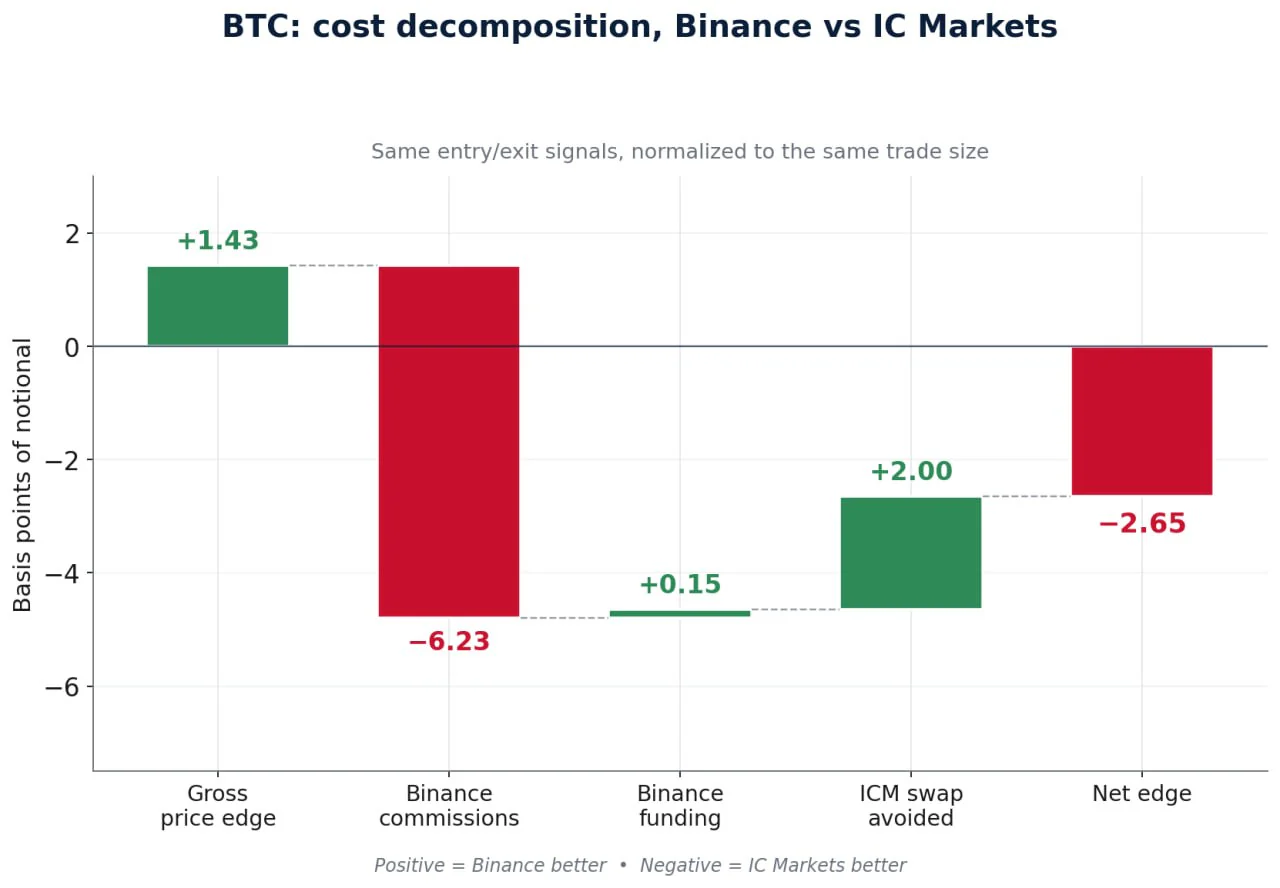
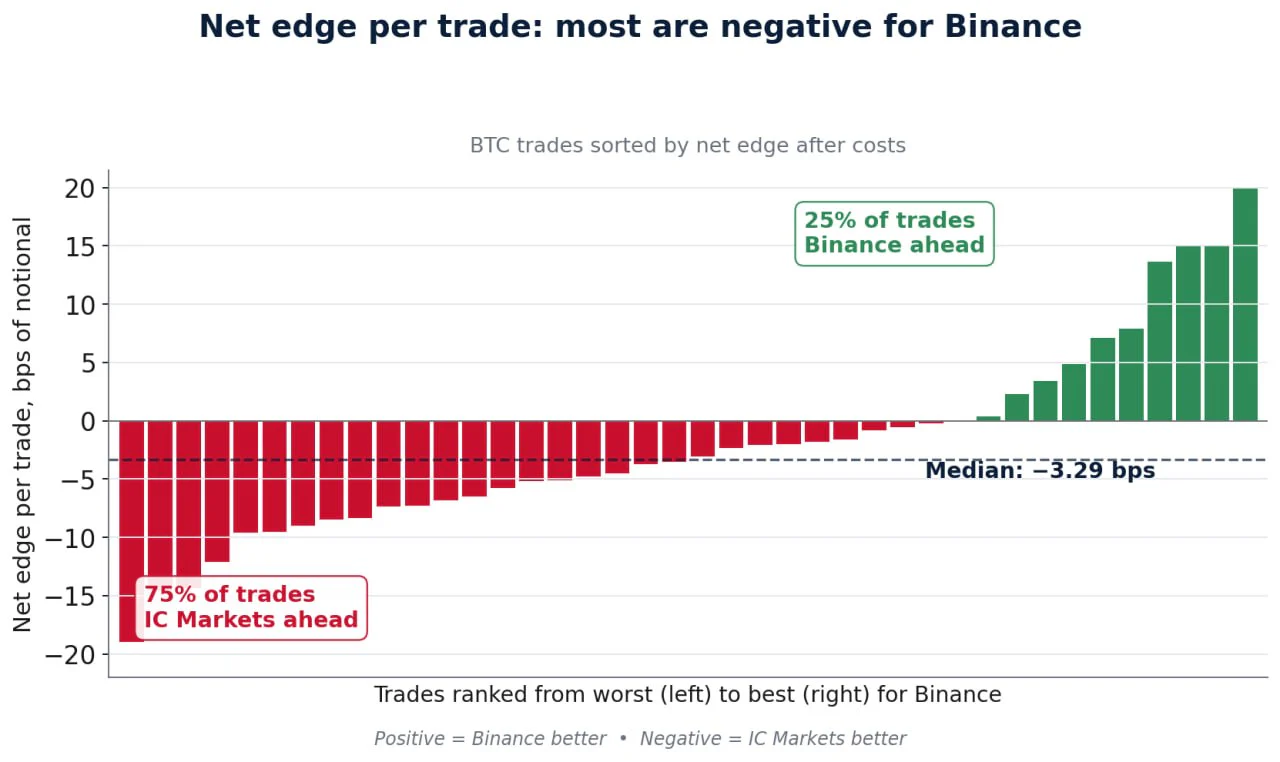
That decomposition highlights how commissions and funding can flip a raw price advantage into a net disadvantage for an exchange. A second chart of ranked trades shows most individual signals favor the FX route after costs:
When FX brokers win
- Short intraday trades where funding is negligible and spreads/execution are tight.
- Retail traders without high VIP tiers on exchanges who pay per‑trade commissions.
- Scenarios where swap avoidance on CFDs reduces overnight drag for quick turn trades.
When exchanges still win
- Large institutional flows and deep liquidity needs.
- High VIP traders or those who hold positions overnight and benefit from lower funding.
- Special cases where raw price and maker rebates outweigh commission schedules.
Practical trading styles and links
Match venue choice to your style:
- News Trading — requires liquidity and fast fills; exchanges often lead for large moves.
- Trend Trading — longer holds can favor lower funding costs on exchanges.
- Range Trading — tight execution and low commissions matter.
- Day Trading and End-of-Day Trading — FX brokers often win for intraday pivots.
- Swing Trading — funding and overnight costs become decisive.
- Scalping — execution and spread are critical.
- Position Trading and Gap Trading — choose by order type and holding horizon.
- Algorithmic Trading — backtest both venues on your signals.
- Breakout Trading and Momentum Trading — execution slippage matters most.
- Mean Reversion and Fibonacci Retracement — test net edge per trade.
Checklist for retail traders
- Backtest your exact entry/exit signals on both venues including commissions and funding.
- Compare net edge per trade, not just raw price.
- Factor in VIP tiers, rebates, and whether you hold overnight.
- Consider execution quality and slippage during volatile events.
Final takeaways
For many retail intraday BTC strategies in 2026, CFDs at IC Markets can be cheaper after commissions and funding are included. Exchanges like Binance still win in specific scenarios — especially for high‑volume, overnight, or VIP traders. Use careful backtesting and include all cost lines when choosing a venue.
Disclosure: This article summarizes industry observations and third‑party analysis from Algocrat AI. It is educational and not financial advice; consult a licensed advisor for personal guidance.