





Menu


This page may contain paid affiliate links. If you buy or register through them, MyFxBots may earn a commission or referral fee. See our disclaimer for details.


Happy Gold is a gold system for MT4 and MT5 that its developer presents as a hybrid of Scalping and Swing Trading, built on a modified ZigZag indicator and limited to one open trade. It targets XAUUSD from M15 to H4 and ships in two builds. This review covers both builds, the published inputs, the tester reports, and the live records.
Trading Idea
Happy Gold implements one premise: a ZigZag reading locates where price has already turned, and a fresh move away from such a point more often continues than fails. So it does not buy the reversal — it waits for price to commit and enters by placing a pending stop order a set distance beyond the indicator's last extreme, which is Breakout Trading applied to gold. The claimed edge is entry timing, not forecasting.
Specifications
A gold system on a single symbol lives or dies on execution, and the spread at the moment a stop order fills matters more than the average quoted on a comparison page. Tickmill, and IC Markets covers the broker side, and TradingFX VPS VPS keeps the terminal running when a home connection would break the sequence. Neither is a condition of the licence.
The purchase is a licence for real accounts — two or five of them depending on the package, with demo accounts unlimited. It is bound to the broker account number rather than to a person, starts as a one-month licence and then converts to a lifetime one at no further charge. A single licence covers two accounts on MT4 or two on MT5, or one on each platform, but not four; one change of real account is allowed on the two-account and five-account packages.
The system is published for an ECN account, with a maximum spread of twenty pips and very low slippage, and the vendor names ECN or market-maker execution as the conditions it was designed around. No broker whitelist, hedging restriction or compatibility list is published, so the spread and slippage figures are performance conditions rather than a compatibility requirement.
Two documents are listed with the purchase: a user guide in English and an installation guide. The vendor calls the pair a complete tutorial; no parameter reference, video walkthrough or translated edition is listed, so a non-English reader should assume the material arrives in English only.
Updates and upgrades are free with the purchase, and the vendor states it will keep improving the products. The changelog shows what that has meant: source rebuilds for new terminal builds, added inputs, fixes to stop and take-profit modification, and additional strategy builds. No support horizon or end date for the free updates is published.
Happy Gold is not sold on its own: it comes inside the vendor's ten-EA package, and that purchase includes a free copy of Happy INDIcators PRO and unlimited demo accounts. The notes for the later release also record a bonus MT5 version added alongside the MT4 build. No separate account credit, VPS trial, or broker offer is attached to the licence.
The product page states a thirty-day money-back guarantee and refers the buyer to the vendor's terms for the conditions attached to it. Those terms are not linked as a readable page from the pages the desk fetched, so the window is published and its conditions are not — a buyer should ask for them in writing before counting on the guarantee.
Both platforms are supported inside the same purchase, and each receives both a Scalp-Swing executable and a GridNews one. The branches do not share version numbers — the MT4 and MT5 lines are numbered separately — and their settings files are published per platform, so a trader already on MT5 should confirm that the preset they intend to use exists for that branch.
Support runs through email, a live chat on the site, and remote sessions over TeamViewer and AnyDesk, and the vendor states the team works around the clock. The contact page itself carries only a message form and a Facebook link — no support address, response target, or language list — so a buyer should obtain the email address before depending on it.
The requirements block gives a minimum deposit of 100 USD. That figure is not broken down by risk preset, by lot size or by the spread a broker charges, so it reads as the floor for opening an account rather than a size at which the shipped settings behave like the published tests.
The account is specified only as an ECN account on MT4 or MT5; the vendor publishes no leverage requirement, no account-currency requirement and no position on swap-free accounts. Because the strategy is described as non-hedging and holds one position at a time, the netting-versus-hedging question is unlikely to bind — but it is not addressed either.
Windows 7, 8, 10, and 11 are listed together with macOS and Linux. The MT4 and MT5 terminals are native to Windows; on macOS and Linux, the vendor's line implies the terminal through the platform's own installer or a compatibility layer, and does not say which, so a Mac or Linux buyer should confirm the route before paying.
Installation is via an executable: the purchase contains one .exe for each platform and strategy combination, and the vendor describes setup as a few clicks. An installation guide ships with them, and the release notes show the executables being rebuilt for new terminal builds, so the file a buyer downloads should match the terminal version they run.
XAUUSD (GOLD)
M15–H4. Published presets: Scalp on M15 and M30; Swing on H1 and H4 (2 charts per set in the vendor's examples)
Developed By
Happy Forex
About
Happy Gold

Reviewed By
MyFxBots Admin
Last Reviewed On
Sun, 8 Nov 2026
3rd Party-Verified Happy Gold's Live Trading Result Statements
The live evidence for Happy Gold is published as embedded tracking widgets on the product page, and the desk opened those records on 8 November 2026. Most of them are Myfxbook accounts the vendor labels as real and runs on the Scalp setting at M30; one is an FXBlue record labelled as a real account on the GridNews setting; the rest cover earlier builds of the same system. Because the records sit on independent tracking services rather than on the vendor's own server, they can be opened, compared and watched by anyone.
Two limits apply before any of it is read as evidence. The accounts are vendor-run: the vendor chooses what to connect, when to stop publishing and which account size to show, and no record carries a third-party audit. The embedded widgets also return their figures through scripts that did not render in the page the desk fetched, so the return, the drawdown and the trade history were not read directly and are not characterised in this review. A tracked account also reflects one broker's spreads and one stretch of market conditions, and past performance on it does not predict what a different account will do.
 Forex Trading System By Forex Trader HappyForex&titles=12&chartbgc=FFFFFF&magic=-1&equityColor=FF890E "Happy Gold - VTMarkets (M30) Forex Trading System By Forex Trader HappyForex")
Started On
Jun 09, 2021
Leverage
1:500
Broker
VT Markets
Starting Balance
$5000
Total Gain
+4,293.49%
Tracking Record Summary
Started On
Jun 09, 2021
Account Leverage
1:500
Profit Factor
2.00
Total Gain
+4,293.49%
Absolute Gain
+1,164.66%
Monthly Gain
7.67%
Daily Gain
0.25%
Total Pips
29,516.0
Total Trades
907
Profit Amount
$58,232.81
(%) Won Trades
29,516.0
Drawdown
25.95%
 Forex Trading System By Forex Trader HappyForex&titles=12&chartbgc=FFFFFF&magic=-1&equityColor=FF890E "Happy Gold - TMGM (M30) Forex Trading System By Forex Trader HappyForex")
Tracking Record Summary
Started On
Nov 17, 2021
Account Leverage
1:500
Profit Factor
2.60
Total Gain
+2,544.56%
Absolute Gain
+443.68%
Monthly Gain
7.41%
Daily Gain
0.24%
Total Pips
26,978.0
Total Trades
796
Profit Amount
$24,794.86
(%) Won Trades
26,978.0
Drawdown
21.52%
 Forex Trading System By Forex Trader HappyForex&titles=12&chartbgc=FFFFFF&magic=-1&equityColor=FF890E "Happy Gold - Eightcap (M30) Forex Trading System By Forex Trader HappyForex")
Tracking Record Summary
Started On
Feb 09, 2023
Account Leverage
1:500
Profit Factor
2.69
Total Gain
+988.26%
Absolute Gain
+988.26%
Monthly Gain
8.05%
Daily Gain
0.26%
Total Pips
18,608.0
Total Trades
535
Profit Amount
$9,882.59
(%) Won Trades
18,608.0
Drawdown
11.70%
Tracking Record Summary
Started On
Jul 27, 2021
Account Leverage
1:100
Profit Factor
1.41
Total Gain
190.46%
Absolute Gain
190.46%
Monthly Gain
2.53%
Daily Gain
0.12%
Total Pips
1,400.9
Total Trades
660
Profit Amount
+6,004.15
(%) Won Trades
1,400.9
Drawdown
1.0%
 Forex Trading System By Forex Trader HappyForex&titles=12&chartbgc=FFFFFF&magic=-1&equityColor=FF890E "Happy Gold - ICMarkets (M30) Forex Trading System By Forex Trader HappyForex")
Started On
Sep 03, 2017
Leverage
1:500
Broker
IC Markets
Starting Balance
$200
Total Gain
+64,454.68%
Tracking Record Summary
Started On
Sep 03, 2017
Account Leverage
1:500
Profit Factor
2.51
Total Gain
+64,454.68%
Absolute Gain
-66,858.58%
Monthly Gain
6.90%
Daily Gain
0.22%
Total Pips
50,301.0
Total Trades
1,649
Profit Amount
$128,762.93
(%) Won Trades
50,301.0
Drawdown
22.61%

 Forex Trading System By Forex Trader HappyForex&titles=12&chartbgc=FFFFFF&magic=-1&equityColor=FF890E "Happy Gold - Tickmill (M15) Forex Trading System By Forex Trader HappyForex")
Started On
Mar 04, 2019
Leverage
1:500
Broker
Tickmill
Starting Balance
$1000
Total Gain
+49,610.07%
Tracking Record Summary
Started On
Mar 04, 2019
Account Leverage
1:500
Profit Factor
1.38
Total Gain
+49,610.07%
Absolute Gain
+49,610.07%
Monthly Gain
8.20%
Daily Gain
0.26%
Total Pips
45,978.0
Total Trades
2,098
Profit Amount
$496,100.66
(%) Won Trades
45,978.0
Drawdown
54.81%

What the live record establishes is procedural. A vendor that keeps public, third-party-tracked accounts across several brokers, both builds, and both settings is offering a buyer something to watch rather than a claim to accept, and that is more than many sellers of this size provide.
What it leaves open is what a decision actually rests on: how the equity curve behaved through the losing stretches, whether the GridNews record and the scalp records diverge in character, and how much of any result depends on the spread the broker charges. Those are answered by opening each record against the account size a buyer would really fund, and by asking which build each one is running.
Happy Gold's Backtests by MetaTrader Strategy Tester using High-Quality Historical Tick Data
This section rests on the report archive published for Happy Gold on the product page and opened by the desk on 8 November 2026. It arrives in two forms: eight strategy-tester pages linked directly, and six compressed archives that each hold one HTML report beside its chart images. Between them, they cover both builds and both platforms — the current MT5 version on real-tick history, and three earlier MT4 versions in every-tick mode — on four different broker servers, from an Eightcap Global server labelled live for the current version down to an Alpari UK demo server for the oldest.
Those differences matter more than any headline result. Each report fixes its own deposit, leverage, spread setting and terminal build, and the platform decides how a trade is counted, so a report from one server is not directly comparable with one from another. What the archive does establish is that the vendor has published the full tester output per preset rather than one selected curve: deposit, spread, balance curve, and complete trade list are all present.
The limits are those of any tester run. These are models, not live trading: stored ticks replayed through the terminal cannot reproduce a dealer's rejection, a requote, a swap charge, or a latency spike, and every run here uses the spread and server the vendor chose. Nothing in them shows how the inputs were arrived at or whether they were fitted to the period tested, and past performance in a model says nothing about the next period.
This is the first member of the archive that Happy Gold publishes, opened by the desk on 8 November 2026: one HTML report inside a compressed download, with its balance, equity, and holding-time charts beside it. It was produced on an Eightcap Global server in the MT5 strategy tester, on a dollar account, over a recent window of real-tick history, with the scalping setting on the half-hour chart. The server name in the header carries the word live; it is an account label inside a tester run, not a live record.
It is modelling, not trading. Stored ticks replayed through the terminal cannot show a requote, a dealer rejection, or a swap charge, and the spread was whatever the vendor set before the run began. Past performance in a model does not predict the next period.
Backtests Settings
Symbol
XAUUSD
Period
M30 (2025.01.01 - 2026.10.01)
Broker
Currency
USD
Leverage
1:500
Symbols
1
Bars in test
20662
Ticks modelled
68758959
Modelling quality
99% real ticks
Initial Deposit
$1000.00
Backtests Results
Total net profit
441.60
Gross profit
935.18
Gross loss
-493.58
Profit factor
1.89
Expected payoff
1.52
Margin level
2053.39%
Absolute Bal DD
39.40
Maximal Bal DD
66.78 (4.59%)
Relative Bal DD
6.14% (62.88)
Absolute EQ DD
39.92
Maximal EQ DD
71.88 (4.92%)
Relative EQ DD
6.31% (64.64)
Recovery Factor
6.14
Sharp Ratio
89.71
Z-Score
-0.60 (45.15%)
AHPR
1.0013 (0.13%)
LR Correlation
0.85
OnTester result
-
GHPR
1.0013 (0.13%)
LR Standard Error
79.68
Total Trades
290
Short positions
137 (64.96%)
Long positions
153 (71.90%)
Profit trades
199 (68.62%)
Loss trades
91 (31.38%)
Largest Profit trade
49.44
Largest Loss trade
-27.18
Average Profit trade
4.70
Average Loss trade
-5.42
Maximum consecutive wins (profit in money)
14 (19.24)
Maximum consecutive losses (loss in money)
5 (-30.28)
Maximal consecutive profit (count of wins)
98.23 (10)
Maximal consecutive loss (count of losses)
-58.50 (4)
Avarage consecutive wins
3
Avarage consecutive losses
2
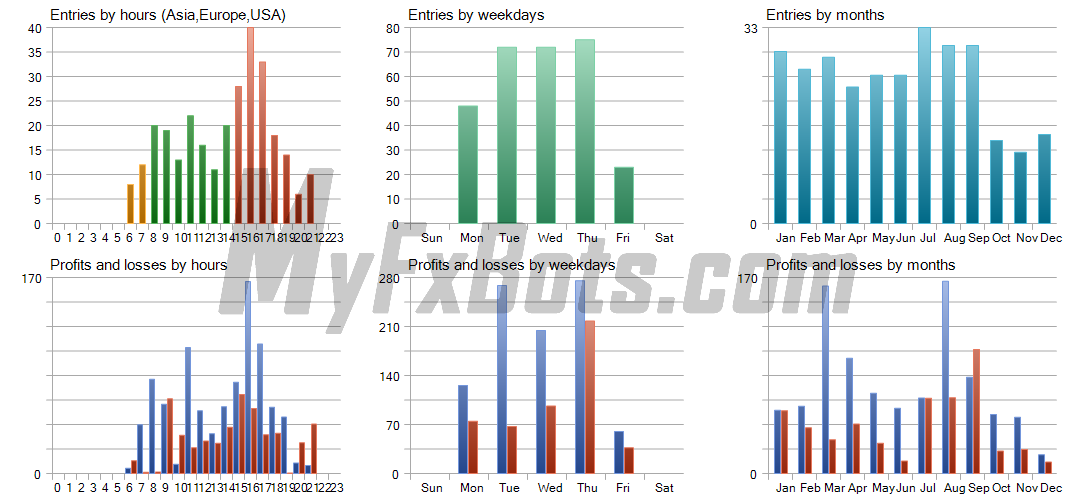
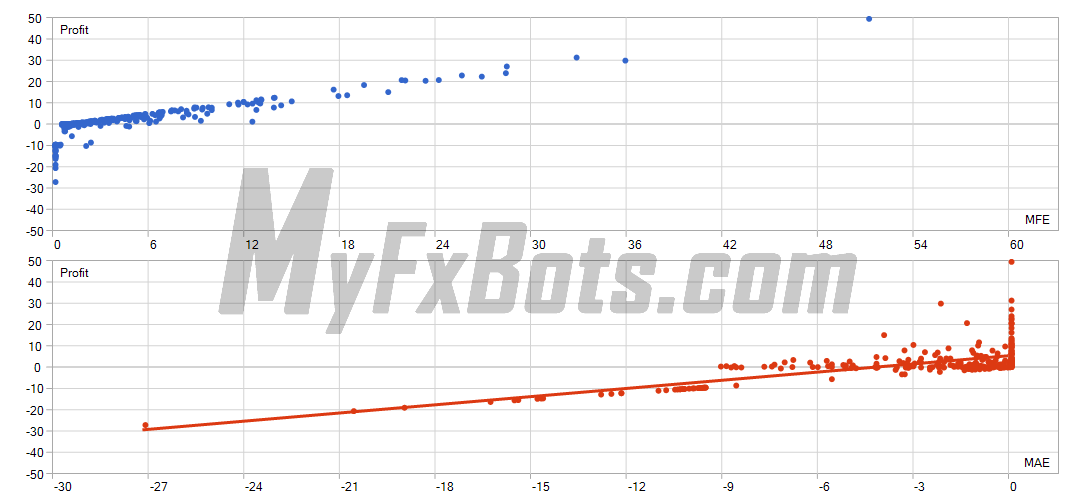
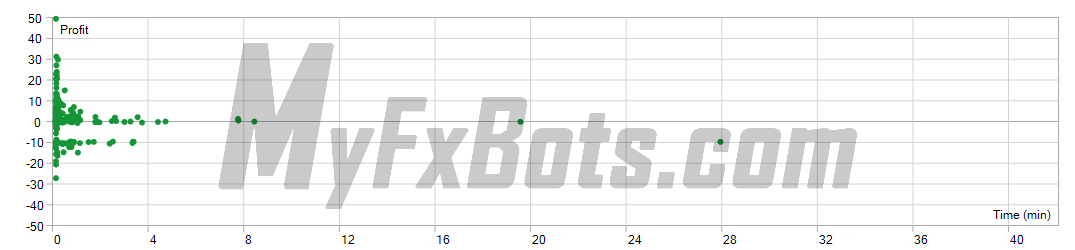
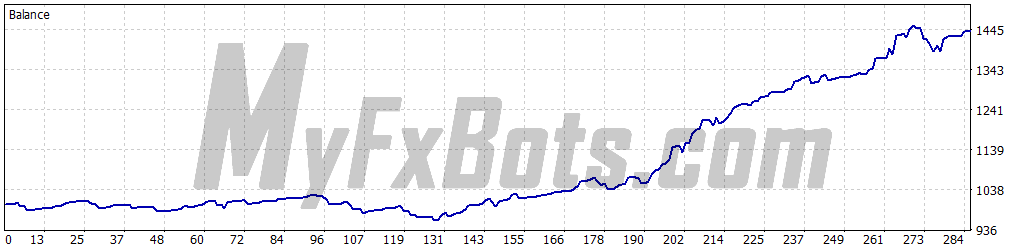
The run shows a long sequence of trades with most of them closing in profit, a profit factor comfortably clear of break-even, and a drawdown that stays small beside the deposit. It establishes that the current scalp build holds together on real-tick history at a modest risk setting. It cannot show how the same logic behaves when a broker widens the spread or slips a stop, which is where a gold scalper's edge usually goes.
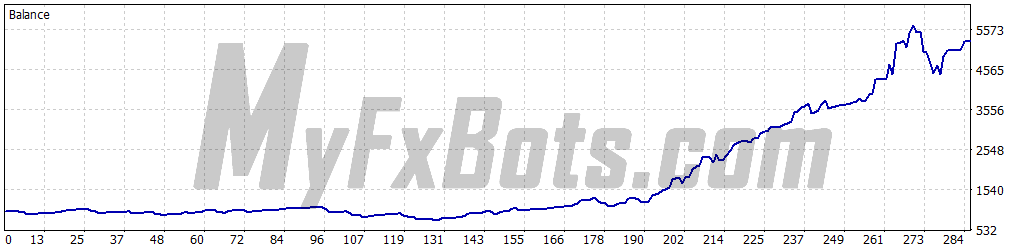
This is the same scalp run at the higher risk setting: same server, same real-tick window, same half-hour chart, and — as a comparison of the two trade lists shows — the same entries in the same order. The only material change is the lot the risk input produces.
The caveat is the one that applies to every file here: a tester rebuilds fills from stored prices, charges no swap, and never refuses an order, and the spread is the vendor's chosen setting rather than the one a reader's account would see. No model run predicts a live period.
Backtests Settings
Symbol
XAUUSD
Period
M30 (2025.01.01 - 2026.10.01)
Broker
Currency
USD
Leverage
1:500
Symbols
1
Bars in test
20662
Ticks modelled
68758959
Modelling quality
99% real ticks
Initial Deposit
$1000.00
Backtests Results
Total net profit
4295.28
Gross profit
8855.96
Gross loss
-4560.68
Profit factor
1.94
Expected payoff
14.81
Margin level
443.42%
Absolute Bal DD
222.56
Maximal Bal DD
1 239.42 (21.80%)
Relative Bal DD
29.52% (325.60)
Absolute EQ DD
224.64
Maximal EQ DD
1 332.96 (23.12%)
Relative EQ DD
30.16% (334.81)
Recovery Factor
3.22
Sharp Ratio
82.05
Z-Score
-0.60 (45.15%)
AHPR
1.0063 (0.63%)
LR Correlation
0.81
OnTester result
-
GHPR
1.0058 (0.58%)
LR Standard Error
802.19
Total Trades
290
Short positions
137 (64.96%)
Long positions
153 (71.90%)
Profit trades
199 (68.62%)
Loss trades
91 (31.38%)
Largest Profit trade
766.32
Largest Loss trade
-525.48
Average Profit trade
44.50
Average Loss trade
-50.12
Maximum consecutive wins (profit in money)
14 (106.11)
Maximum consecutive losses (loss in money)
5 (-151.21)
Maximal consecutive profit (count of wins)
850.25 (3)
Maximal consecutive loss (count of losses)
-1 068.50 (4)
Avarage consecutive wins
3
Avarage consecutive losses
2
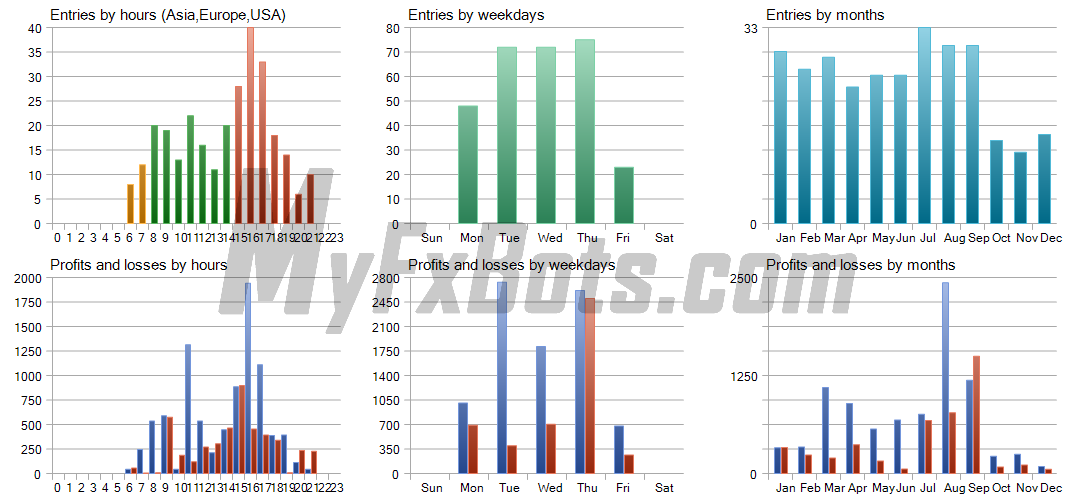
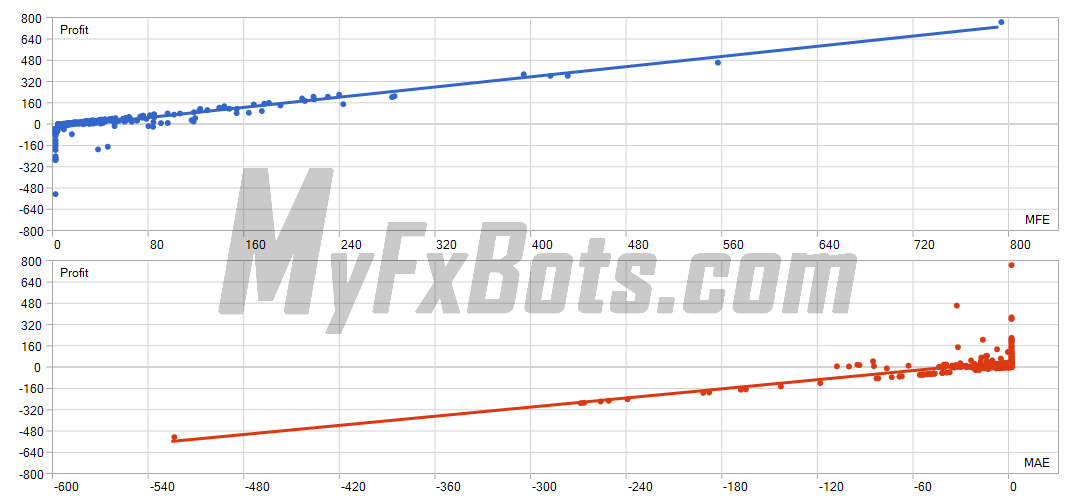
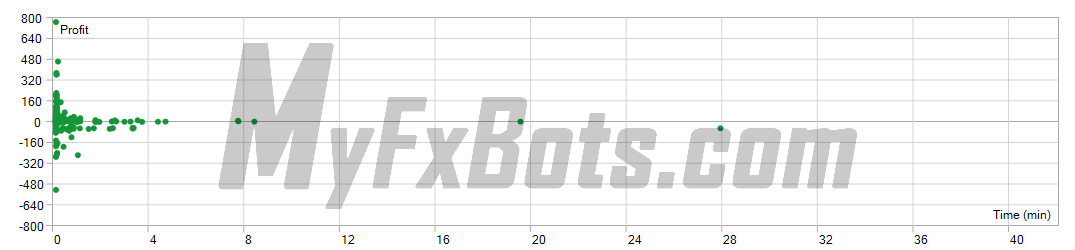
Because the entry list is unchanged, this pair isolates sizing and nothing else: profit grows roughly with the lot, and so does the drawdown, which moves from negligible to a size that would dominate an account's month. That is the useful reading of the two reports together — the risk input is a straight multiplier on one fixed sequence, so choosing it is a decision about how much of the balance the reader will watch disappear in a bad stretch, not about how many signals the system finds.
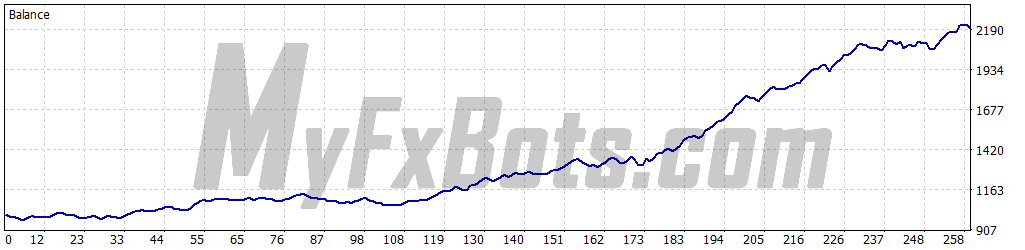
The third file belongs to the swing family, and its name states the design: a stop of two hundred against a target of two hundred, equal on both sides. It covers the same Eightcap server and the same real-tick window as the scalp reports, but on the hourly chart, and it arrives inside its own archive with its chart images.
As modelling it fixes the spread and fills every order at the stored price, a live hourly position held through a news release would not always do either. Past performance here does not predict the next period.
Backtests Settings
Symbol
XAUUSD
Period
H1 (2025.01.01 - 2026.10.04)
Broker
Currency
USD
Leverage
1:500
Symbols
1
Bars in test
10382
Ticks modelled
69121627
Modelling quality
99% real ticks
Initial Deposit
$1000.00
Backtests Results
Total net profit
1192.56
Gross profit
2131.26
Gross loss
-938.70
Profit factor
2.27
Expected payoff
4.50
Margin level
1853.45%
Absolute Bal DD
30.95
Maximal Bal DD
71.38 (6.27%)
Relative Bal DD
6.27% (71.38)
Absolute EQ DD
32.60
Maximal EQ DD
79.43 (6.98%)
Relative EQ DD
6.98% (79.43)
Recovery Factor
15.01
Sharp Ratio
112.81
Z-Score
-2.34 (98.07%)
AHPR
1.0030 (0.30%)
LR Correlation
0.92
OnTester result
-
GHPR
1.0030 (0.30%)
LR Standard Error
149.58
Total Trades
265
Short positions
110 (50.91%)
Long positions
155 (48.39%)
Profit trades
131 (49.43%)
Loss trades
134 (50.57%)
Largest Profit trade
46.97
Largest Loss trade
-46.09
Average Profit trade
16.27
Average Loss trade
-7.01
Maximum consecutive wins (profit in money)
7 (168.46)
Maximum consecutive losses (loss in money)
11 (-60.53)
Maximal consecutive profit (count of wins)
168.46 (7)
Maximal consecutive loss (count of losses)
-60.53 (11)
Avarage consecutive wins
2
Avarage consecutive losses
2
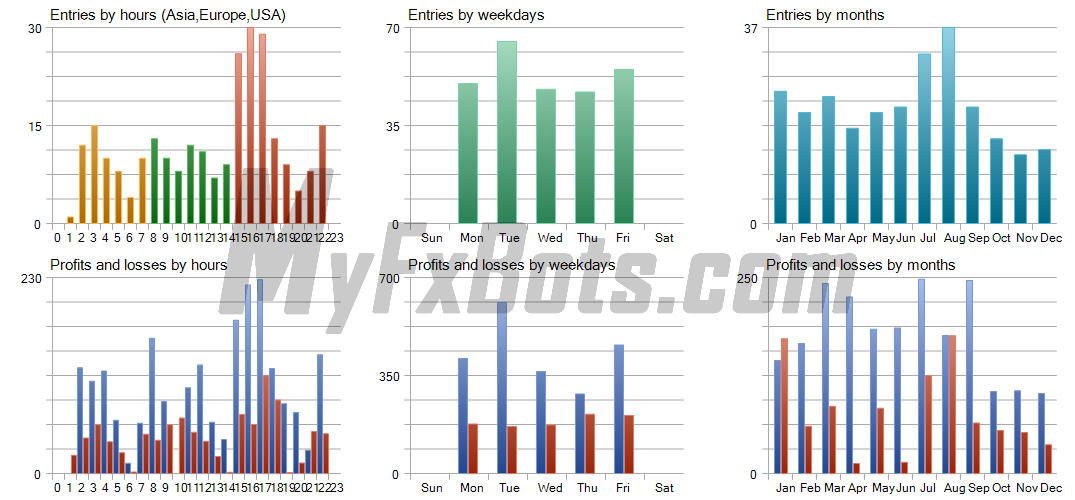
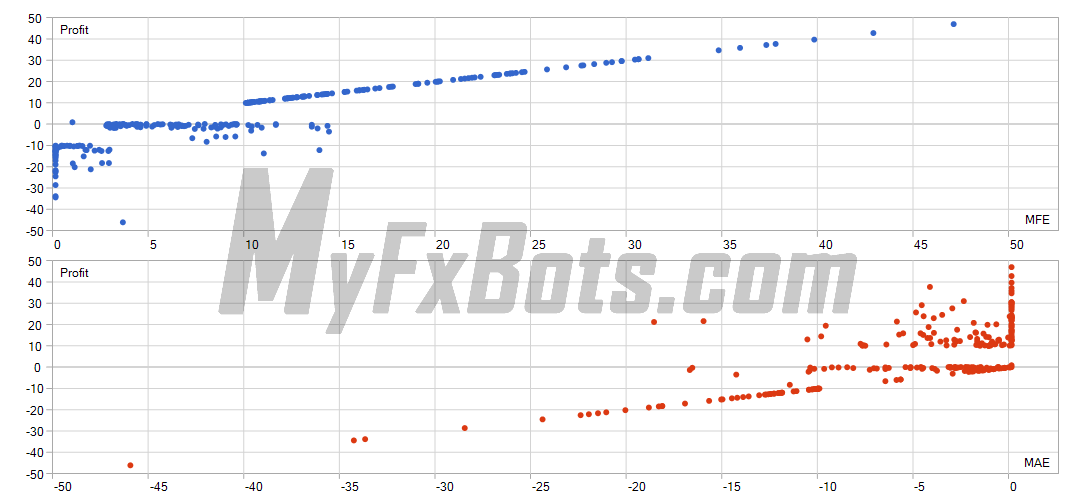
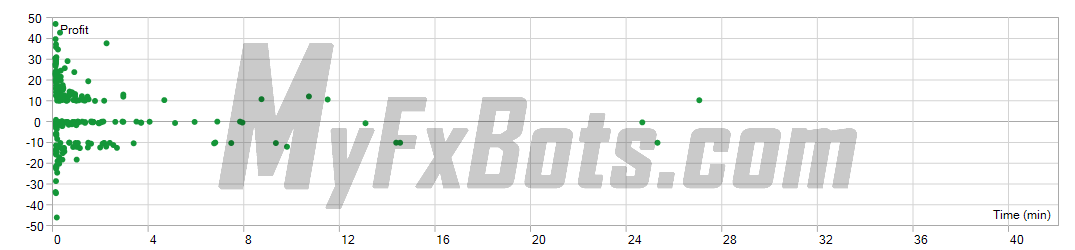
With the target matching the stop, the hit rate sits close to a coin flip, and the run still clears break-even comfortably, which is what a small per-trade edge looks like over a long trade list with low drawdown. It is the cleanest of the swing reports for judging consistency, precisely because the target is doing none of the work.
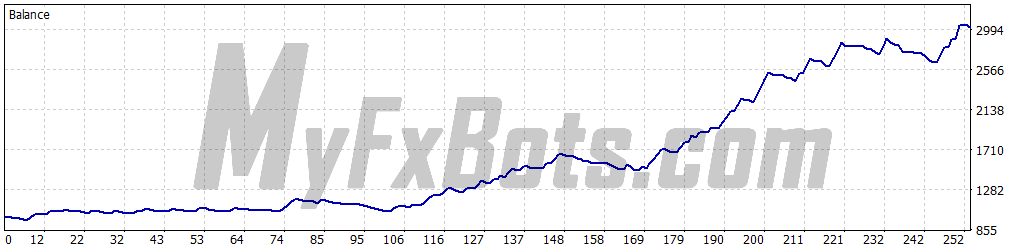
This is the same hourly entry list with the target widened to three times the stop. Archive, server, and window match the previous file; what changed is where the winning trades are closed.
The report is a model of one exit rule, not a record of trading: fills come from stored ticks at the vendor's spread, and a live position would incur swap and slippage that the tester does not charge. A model run says nothing about the coming period.
Backtests Settings
Symbol
XAUUSD
Period
H1 (2025.01.01 - 2026.10.04)
Broker
Currency
USD
Leverage
1:500
Symbols
1
Bars in test
10382
Ticks modelled
69121627
Modelling quality
99% real ticks
Initial Deposit
$1000.00
Backtests Results
Total net profit
2007.78
Gross profit
3569.56
Gross loss
-1561.78
Profit factor
2.29
Expected payoff
7.58
Margin level
1823.99%
Absolute Bal DD
41.25
Maximal Bal DD
263.54 (9.07%)
Relative Bal DD
11.22% (132.68)
Absolute EQ DD
42.90
Maximal EQ DD
265.62 (9.14%)
Relative EQ DD
12.83% (153.90)
Recovery Factor
7.56
Sharp Ratio
67.60
Z-Score
-2.20 (97.22%)
AHPR
1.0043 (0.43%)
LR Correlation
0.91
OnTester result
-
GHPR
1.0042 (0.42%)
LR Standard Error
263.66
Total Trades
265
Short positions
110 (36.36%)
Long positions
155 (29.68%)
Profit trades
86 (32.45%)
Loss trades
179 (67.55%)
Largest Profit trade
149.10
Largest Loss trade
-58.66
Average Profit trade
41.51
Average Loss trade
-8.73
Maximum consecutive wins (profit in money)
5 (146.24)
Maximum consecutive losses (loss in money)
13 (-263.54)
Maximal consecutive profit (count of wins)
322.48 (4)
Maximal consecutive loss (count of losses)
-263.54 (13)
Avarage consecutive wins
2
Avarage consecutive losses
4
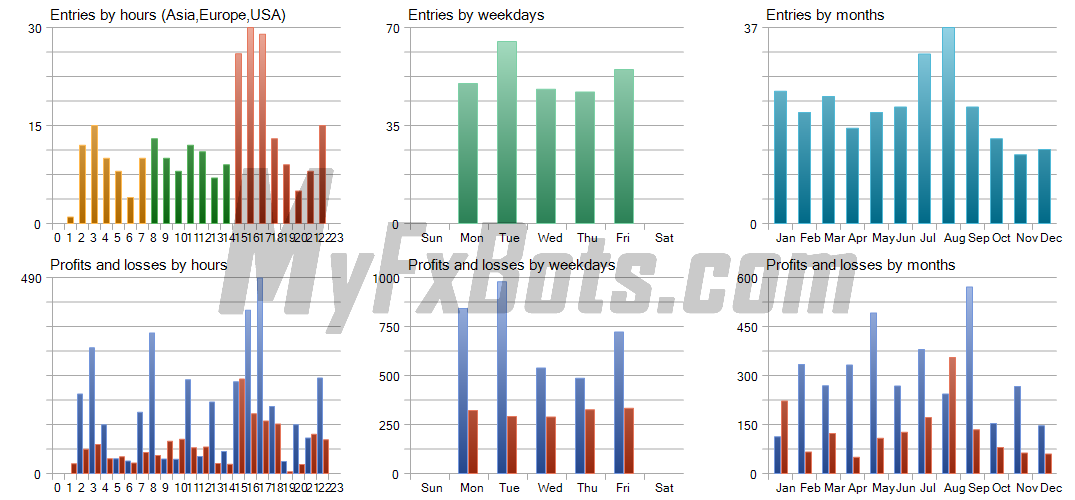
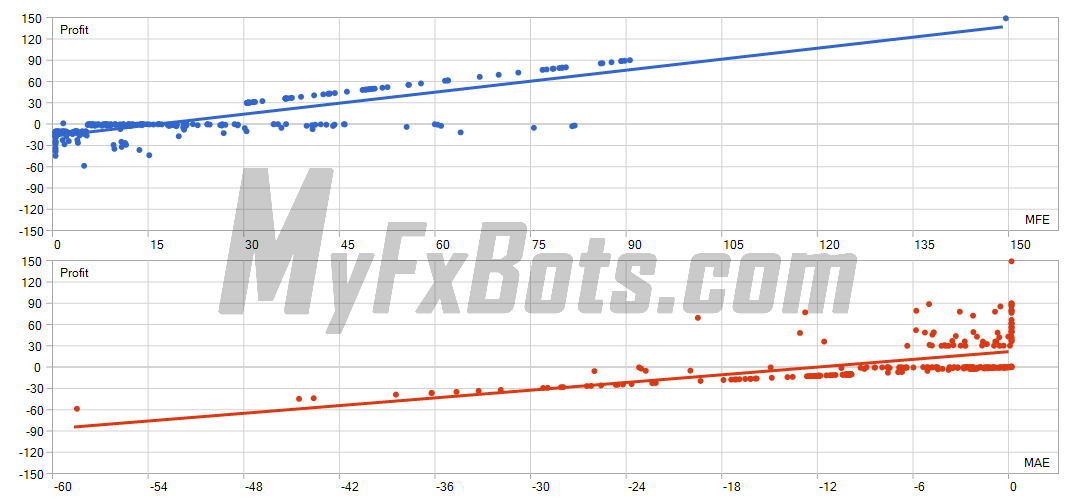
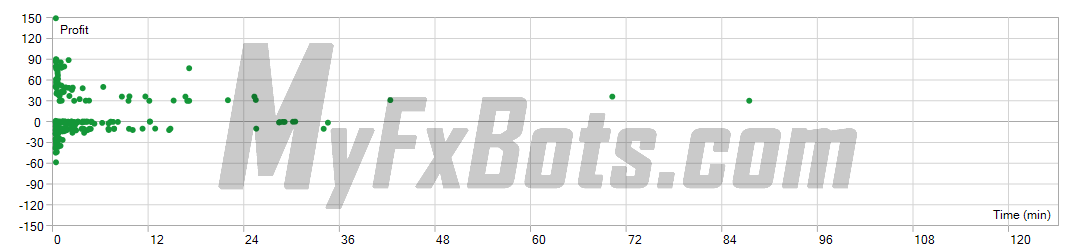
Widening the target trades hit rate for payoff. Most trades now close at a loss, yet the run finishes further ahead than its symmetrical twin, and with a visibly deeper drawdown, because the winners are allowed to run three times as far. That is the honest trade-off in this family: the flattering line is the profit, and the line beside it is the losing streak a reader would have to sit through.
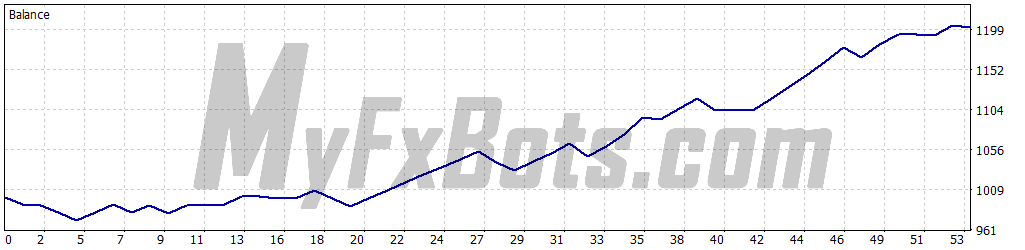
The last of the four swing archives moves to the four-hour chart with a three-hundred stop against a three-hundred target. Same server, same window, and the same real-tick basis as its siblings.
Modelling again: stored ticks, the vendor's spread, no swap and no rejection. A four-hour rule in particular would live through gaps the tester smooths over, so the reconstructed run is the friendliest version of this rule. Past performance does not predict what follows.
Backtests Settings
Symbol
XAUUSD
Period
H4 (2025.01.01 - 2026.10.04)
Broker
Currency
USD
Leverage
1:500
Symbols
1
Bars in test
2715
Ticks modelled
69121627
Modelling quality
99% real ticks
Initial Deposit
$1000.00
Backtests Results
Total net profit
202.30
Gross profit
339.37
Gross loss
-137.07
Profit factor
2.48
Expected payoff
3.82
Margin level
2642.38%
Absolute Bal DD
27.18
Maximal Bal DD
27.18 (2.72%)
Relative Bal DD
2.72% (27.18)
Absolute EQ DD
29.01
Maximal EQ DD
29.85 (2.98%)
Relative EQ DD
2.98% (29.85)
Recovery Factor
6.78
Sharp Ratio
94.71
Z-Score
-0.49 (37.59%)
AHPR
1.0035 (0.35%)
LR Correlation
0.95
OnTester result
-
GHPR
1.0035 (0.35%)
LR Standard Error
22.85
Total Trades
53
Short positions
19 (63.16%)
Long positions
34 (50.00%)
Profit trades
29 (54.72%)
Loss trades
24 (45.28%)
Largest Profit trade
19.84
Largest Loss trade
-14.96
Average Profit trade
11.70
Average Loss trade
-5.71
Maximum consecutive wins (profit in money)
7 (64.53)
Maximum consecutive losses (loss in money)
4 (-27.18)
Maximal consecutive profit (count of wins)
75.20 (5)
Maximal consecutive loss (count of losses)
-27.18 (4)
Avarage consecutive wins
2
Avarage consecutive losses
2
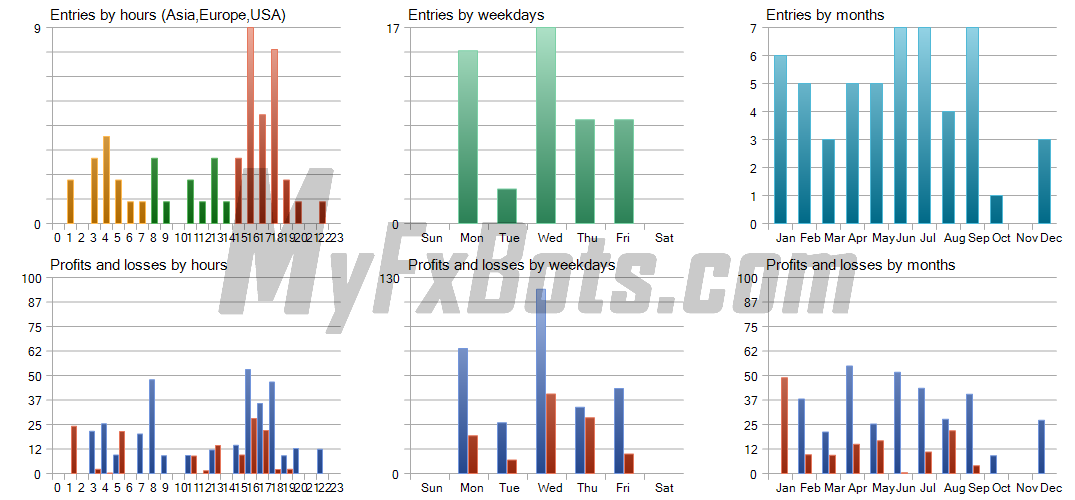
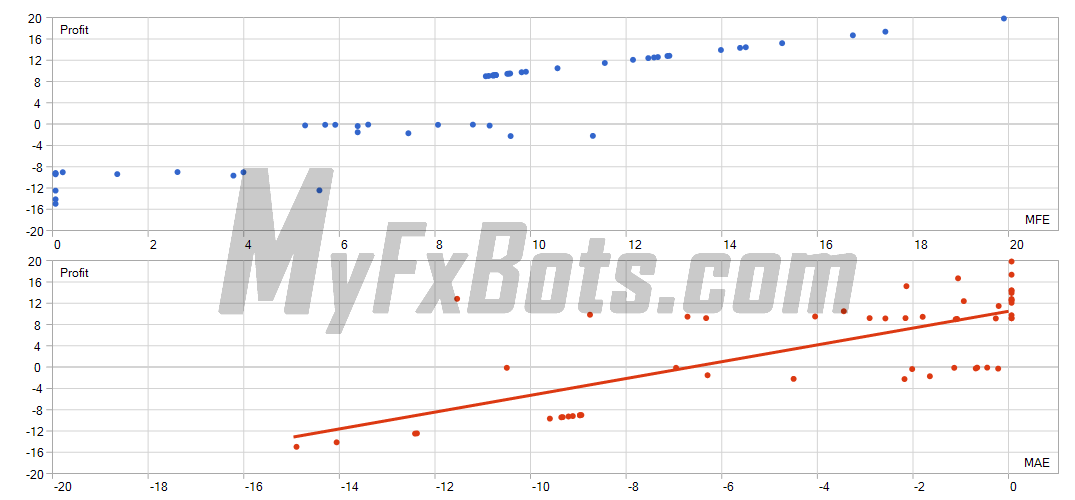
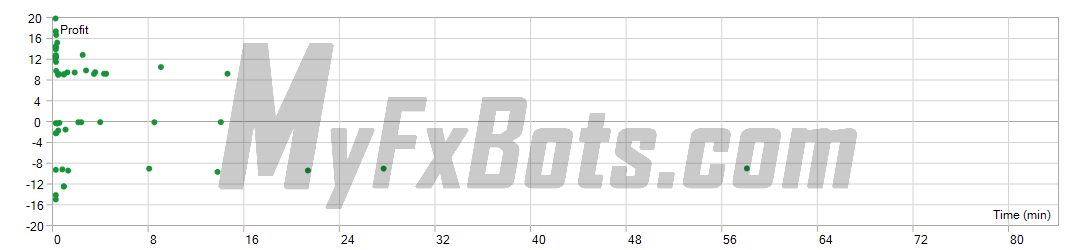
The sample here is thin — a long window of four-hour trading still produces a list short enough to read in one sitting — and a list that short cannot rank a system, whatever the ratio says. The run closes in profit and keeps its drawdown small, and both facts deserve to be discounted for the sample rather than read as confirmation of the hourly results.
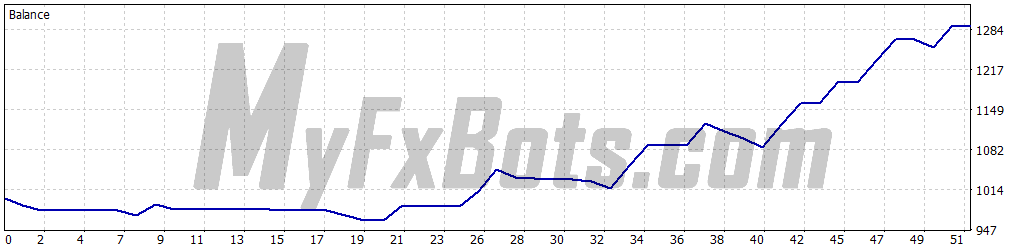
The widest target in the family: a four-hour chart, a four-hundred stop against a twelve-hundred target. Archive, server, and window match the previous file; only the exit moved.
As with its siblings, this is a reconstruction, not a record, and a four-hour rule is the one most likely to meet a weekend gap the tester cannot charge for. Model results do not carry into live trading.
Backtests Settings
Symbol
XAUUSD
Period
H4 (2025.01.01 - 2026.10.04)
Broker
Currency
USD
Leverage
1:500
Symbols
1
Bars in test
2715
Ticks modelled
69121627
Modelling quality
99% real ticks
Initial Deposit
$1000.00
Backtests Results
Total net profit
289.97
Gross profit
435.71
Gross loss
-145.74
Profit factor
2.99
Expected payoff
5.47
Margin level
3253.81%
Absolute Bal DD
36.60
Maximal Bal DD
39.30 (3.49%)
Relative Bal DD
3.66% (36.60)
Absolute EQ DD
39.06
Maximal EQ DD
41.38 (4.13%)
Relative EQ DD
4.13% (41.38)
Recovery Factor
7.01
Sharp Ratio
39.92
Z-Score
-0.19 (15.07%)
AHPR
1.0049 (0.49%)
LR Correlation
0.89
OnTester result
-
GHPR
1.0048 (0.48%)
LR Standard Error
45.72
Total Trades
53
Short positions
19 (31.58%)
Long positions
34 (32.35%)
Profit trades
17 (32.08%)
Loss trades
36 (67.92%)
Largest Profit trade
37.86
Largest Loss trade
-14.79
Average Profit trade
25.63
Average Loss trade
-4.05
Maximum consecutive wins (profit in money)
3 (73.77)
Maximum consecutive losses (loss in money)
7 (-17.96)
Maximal consecutive profit (count of wins)
74.61 (2)
Maximal consecutive loss (count of losses)
-39.30 (3)
Avarage consecutive wins
2
Avarage consecutive losses
3
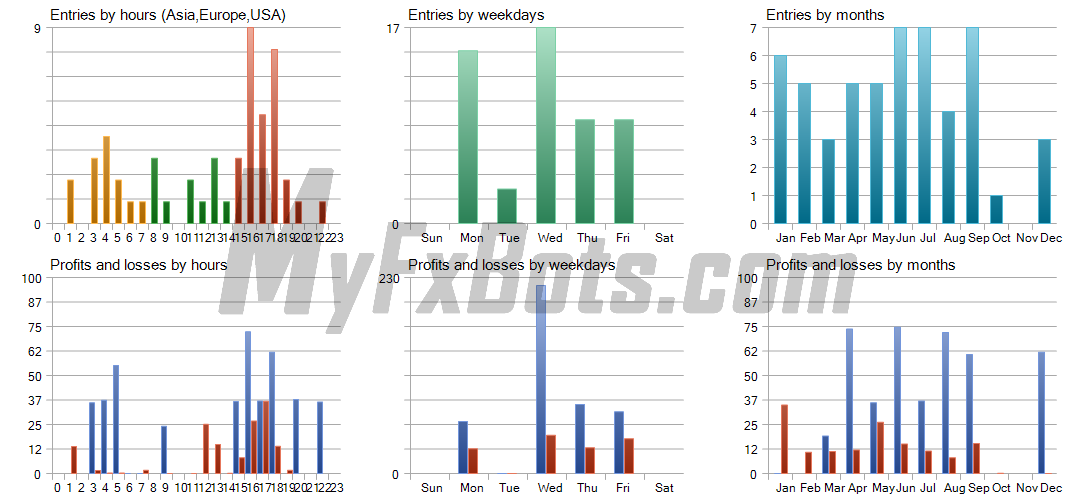
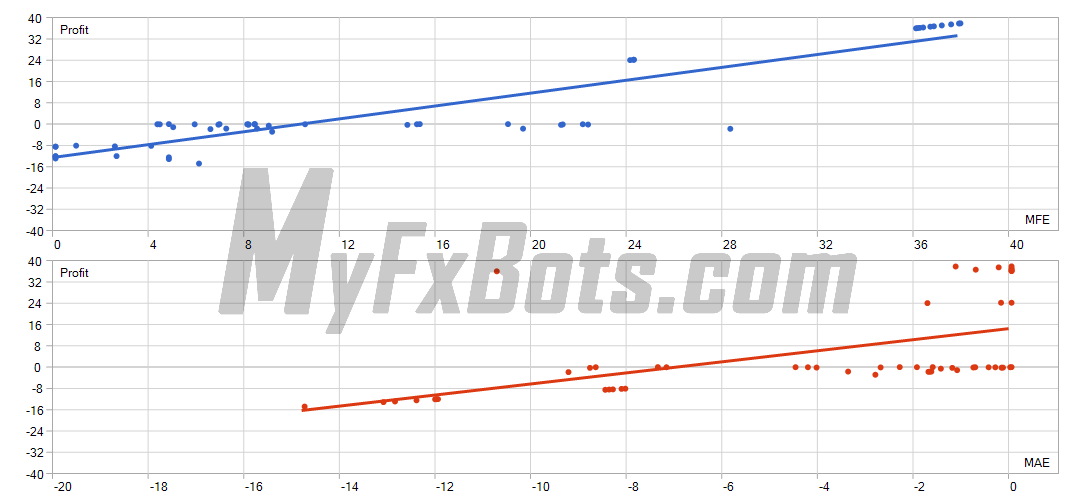
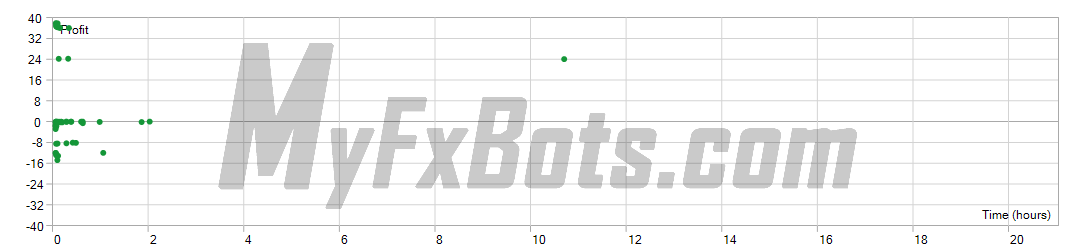
Pushing the target out again lowers the hit rate and raises the ratio, while the drawdown stays modest — on the same short list. The two four-hour reports together read as a promising shape without the evidence to support it, which is a different thing from a bad result and should not be sold to a reader as a good one either.
This file is the MT4 side of the archive: a tester page linked directly rather than packed in an archive, produced on an IC Markets demo server with the scalp build, over a short window of every-tick modelling and a fixed spread setting.
Every-tick mode is the most precise the platform offers and still not live: the tester cannot charge a swap, refuse an order, or widen the spread mid-trade. One window is also one set of market conditions. Past performance does not predict the future.

Backtests Settings
Symbol
XAUUSD (Gold vs US Dollar)
Period
15 Minutes (M15) 2018.12.04 00:00 - 2019.12.03 23:59 (2019.01.01 - 2019.12.04)
Broker
Model
Every tick (the most precise method based on all available least timeframes)
Parameters
- Happy Gold v18 2019 All rights reserved
Bars in test
23626
Ticks modelled
36441615
Modelling quality
99.90%
Initial Deposit
$1000.00
Spread
Current (10)
Backtests Results
Total net profit
2352.62
Gross profit
4888.71
Gross loss
-2536.09
Profit factor
1.93
Expected payoff
5.59
Absolute Bal DD
15.33
Maximal Bal DD
448.33
Relative Bal DD
15.99% (219.20)
Total Trades
421
Short positions
193 (95.34%)
Long positions
228 (92.98%)
Profit trades
396 (94.06%)
Loss trades
25 (5.94%)
Largest Profit trade
109.20
Largest Loss trade
-184.80
Average Profit trade
12.35
Average Loss trade
-101.44
Maximum consecutive wins (profit in money)
2 (-127.20)
Maximum consecutive losses (loss in money)
-
Maximal consecutive profit (count of wins)
1065.67 (51)
Maximal consecutive loss (count of losses)
-184.80 (1)
Avarage consecutive wins
16
Avarage consecutive losses
1
The run is the most flattering in the scalp series: almost every trade closes in profit, the profit factor clears break-even without much room, and the drawdown stays a small fraction of the deposit. A hit rate that high is the signature of a small target taken repeatedly, and the question it raises is not whether the model made money but what happens to that hit rate when one stop slips.
The same scalp build, the same demo server, and the same year, on the half-hour chart instead of the quarter-hour. The report is a direct tester page like the previous one, with the same every-tick basis and the same fixed spread.
Tester output is a model of fills, not a record of them, and a single year holds one regime. Past performance in a model does not predict a live period.

Backtests Settings
Symbol
XAUUSD (Gold vs US Dollar)
Period
30 Minutes (M30) 2018.12.04 00:00 - 2019.12.03 23:59 (2019.01.01 - 2019.12.04)
Broker
Model
Every tick (the most precise method based on all available least timeframes)
Parameters
- Happy Gold v18 2019 All rights reserved
Bars in test
11817
Ticks modelled
36441615
Modelling quality
99.90%
Initial Deposit
$1000.00
Spread
Current (10)
Backtests Results
Total net profit
518.26
Gross profit
1816.66
Gross loss
-1298.40
Profit factor
1.40
Expected payoff
2.57
Absolute Bal DD
17.43
Maximal Bal DD
410.59
Relative Bal DD
21.36% (410.59)
Total Trades
202
Short positions
99 (91.92%)
Long positions
103 (91.26%)
Profit trades
185 (91.58%)
Loss trades
17 (8.42%)
Largest Profit trade
67.98
Largest Loss trade
-96.00
Average Profit trade
9.82
Average Loss trade
-76.38
Maximum consecutive wins (profit in money)
2 (-127.20)
Maximum consecutive losses (loss in money)
-
Maximal consecutive profit (count of wins)
329.67 (27)
Maximal consecutive loss (count of losses)
-127.20 (2)
Avarage consecutive wins
11
Avarage consecutive losses
1
Coarsening the chart shortens the trade list sharply and costs more than it saves: the profit factor falls towards break-even, and the drawdown deepens to a size that would matter on a funded account. Read beside the quarter-hour run it makes the point that the time-frame choice is a risk decision, not a cosmetic one.
This page covers the swing build on the hourly chart over a long window, produced on a second IC Markets demo server with every-tick modelling. The preset is the symmetrical one: stop and target equal.
The window is longer than the scalp pages offer, and still a model: the tester replays stored ticks at a fixed spread and charges no swap. Past performance does not predict what comes next.

Backtests Settings
Symbol
XAUUSD (Gold vs US Dollar)
Period
1 Hour (H1) 2014.01.01 23:00 - 2018.04.08 23:59 (2014.01.06 - 2018.04.08)
Broker
Model
Every tick (the most precise method based on all available least timeframes)
Parameters
- 1Setting H1 SL200TP200 2018 All rights reserved
Bars in test
25436
Ticks modelled
153203723
Modelling quality
99.90%
Initial Deposit
$1000.00
Spread
Current (10)
Backtests Results
Total net profit
4900.79
Gross profit
8185.38
Gross loss
-3284.59
Profit factor
2.49
Expected payoff
6.09
Absolute Bal DD
23.85
Maximal Bal DD
243.67
Relative Bal DD
7.90% (83.75)
Total Trades
805
Short positions
412 (85.92%)
Long positions
393 (86.51%)
Profit trades
694 (86.21%)
Loss trades
111 (13.79%)
Largest Profit trade
58.00
Largest Loss trade
-60.00
Average Profit trade
11.79
Average Loss trade
-29.59
Maximum consecutive wins (profit in money)
2 (-118.00)
Maximum consecutive losses (loss in money)
-
Maximal consecutive profit (count of wins)
499.15 (20)
Maximal consecutive loss (count of losses)
-118.00 (2)
Avarage consecutive wins
7
Avarage consecutive losses
1
A long window and a long trade list give this report more weight than anything else in the MT4 archive: most trades close in profit, the profit factor clears break-even with room, and the drawdown stays small relative to the deposit. It is the closest thing here to a stability test, and it is still a test of one spread assumption on one server.
The same hourly list with the target tripled. Server, window, and modelling match the previous page; the change is confined to where winners exit.
Because the tester charges no swap and no commission, a rule that holds winners longer is the one most likely to flatter a model. Past performance does not predict the future.

Backtests Settings
Symbol
XAUUSD (Gold vs US Dollar)
Period
1 Hour (H1) 2014.01.01 23:00 - 2018.04.08 23:59 (2014.01.06 - 2018.04.08)
Broker
Model
Every tick (the most precise method based on all available least timeframes)
Parameters
- 2Setting H1 SL200TP600 2018 All rights reserved
Bars in test
25436
Ticks modelled
153203723
Modelling quality
99.90%
Initial Deposit
$1000.00
Spread
Current (10)
Backtests Results
Total net profit
18074.68
Gross profit
30889.58
Gross loss
-12814.90
Profit factor
2.41
Expected payoff
22.62
Absolute Bal DD
3.05
Maximal Bal DD
1540.69
Relative Bal DD
9.20% (1540.69)
Total Trades
799
Short positions
408 (77.21%)
Long positions
391 (79.28%)
Profit trades
625 (78.22%)
Loss trades
174 (21.78%)
Largest Profit trade
576.00
Largest Loss trade
-198.00
Average Profit trade
49.42
Average Loss trade
-73.65
Maximum consecutive wins (profit in money)
4 (-48.00)
Maximum consecutive losses (loss in money)
-
Maximal consecutive profit (count of wins)
2743.77 (20)
Maximal consecutive loss (count of losses)
-476.00 (3)
Avarage consecutive wins
5
Avarage consecutive losses
1
The trade-off repeats: the hit rate drops, the profit rises sharply, and the drawdown deepens with it. On this sample, the wider target is the more profitable choice and also the harder one to sit through, which is the distinction a reader should carry into any decision about which preset to run.
The four-hour member of the swing set, stop and target symmetrical again, on the same window and the same demo server as its hourly siblings.
It is a model: stored ticks replayed at a fixed spread, no swap, no slippage, no gap risk charged. Past performance in the tester says nothing about the next period.
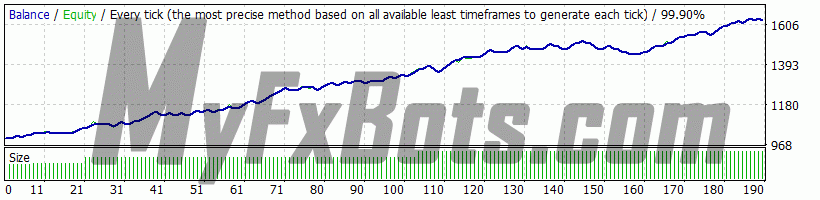
Backtests Settings
Symbol
XAUUSD (Gold vs US Dollar)
Period
4 Hours (H4) 2014.01.01 23:00 - 2018.04.08 23:59 (2014.01.13 - 2018.04.08)
Broker
Model
Every tick (the most precise method based on all available least timeframes)
Parameters
- 3Setting H4 SL300TP300 2018 All rights reserved
Bars in test
6811
Ticks modelled
153203723
Modelling quality
99.90%
Initial Deposit
$1000.00
Spread
Current (10)
Backtests Results
Total net profit
627.32
Gross profit
1101.32
Gross loss
-474.00
Profit factor
2.32
Expected payoff
3.32
Absolute Bal DD
0.42
Maximal Bal DD
82.30
Relative Bal DD
5.40% (82.30)
Total Trades
189
Short positions
97 (77.32%)
Long positions
92 (84.78%)
Profit trades
153 (80.95%)
Loss trades
36 (19.05%)
Largest Profit trade
15.00
Largest Loss trade
-15.00
Average Profit trade
7.20
Average Loss trade
-13.17
Maximum consecutive wins (profit in money)
2 (-30.00)
Maximum consecutive losses (loss in money)
-
Maximal consecutive profit (count of wins)
120.55 (19)
Maximal consecutive loss (count of losses)
-30.00 (2)
Avarage consecutive wins
5
Avarage consecutive losses
1
Four-hour trading over a long window produces a short list, and the report's good numbers — a profit factor well clear of break-even and a tight drawdown — rest on that short list. It is consistent with the hourly results rather than independent confirmation of them.
The last of the MT4 swing pages, and the widest target in it: a four-hundred-point stop against a twelve-hundred-point target on the four-hour chart, same server and the same window.
The model fixes the spread and ignores the overnight gaps a four-hour rule would actually meet; that is the part of this report to distrust. Past performance does not predict future results.

Backtests Settings
Symbol
XAUUSD (Gold vs US Dollar)
Period
4 Hours (H4) 2014.01.01 23:00 - 2018.04.08 23:59 (2014.01.13 - 2018.04.08)
Broker
Model
Every tick (the most precise method based on all available least timeframes)
Parameters
- 4Setting H4 SL400TP1200 2018 All rights reserved
Bars in test
6811
Ticks modelled
153203723
Modelling quality
99.90%
Initial Deposit
$1000.00
Spread
Current (10)
Backtests Results
Total net profit
1060.18
Gross profit
1710.58
Gross loss
-650.40
Profit factor
2.63
Expected payoff
5.67
Absolute Bal DD
9.45
Maximal Bal DD
78.37
Relative Bal DD
4.78% (51.06)
Total Trades
187
Short positions
96 (73.96%)
Long positions
91 (78.02%)
Profit trades
142 (75.94%)
Loss trades
45 (24.06%)
Largest Profit trade
60.53
Largest Loss trade
-20.00
Average Profit trade
12.05
Average Loss trade
-14.45
Maximum consecutive wins (profit in money)
3 (-60.00)
Maximum consecutive losses (loss in money)
-
Maximal consecutive profit (count of wins)
240.62 (10)
Maximal consecutive loss (count of losses)
-60.00 (3)
Avarage consecutive wins
4
Avarage consecutive losses
1
This page carries the strongest ratio of the MT4 swing set and the smallest drawdown, on the shortest trade list of the four. Those three facts belong in one sentence, because the strength of the ratio is partly a function of how little evidence sits behind it.
This is the oldest report in the archive: a build the vendor has long since replaced, run on an Alpari UK demo server in an old terminal build, over a window from well before the current version, on the half-hour chart.
The modelling is every-tick and the spread fixed, but the platform and the market of that period are not the ones a buyer would trade now. Past performance in an obsolete build does not predict anything about the current one.

Backtests Settings
Symbol
XAUUSD (Gold Spot)
Period
30 Minutes (M30) 2010.01.01 00:02 - 2013.10.02 23:59
Broker
Model
Every tick (the most precise method based on all available least timeframes)
Parameters
- Happy Gold v10 2013 All rights reserved
Bars in test
47384
Ticks modelled
70602002
Modelling quality
99.90%
Initial Deposit
$1000.00
Spread
Backtests Results
Total net profit
18428.53
Gross profit
19182.13
Gross loss
-753.60
Profit factor
25.45
Expected payoff
15.96
Absolute Bal DD
1.92
Maximal Bal DD
435.94
Relative Bal DD
8.39% (204.90)
Total Trades
1155
Short positions
520 (82.12%)
Long positions
635 (80.47%)
Profit trades
938 (81.21%)
Loss trades
217 (18.79%)
Largest Profit trade
390.00
Largest Loss trade
-18.00
Average Profit trade
20.45
Average Loss trade
-3.47
Maximum consecutive wins (profit in money)
6 (-7.20)
Maximum consecutive losses (loss in money)
-
Maximal consecutive profit (count of wins)
3146.83 (31)
Maximal consecutive loss (count of losses)
-20.16 (2)
Avarage consecutive wins
6
Avarage consecutive losses
1
The output does not survive a second look. It shows a profit factor no real account produces, a compounded balance far beyond anything the live records approach, and a drawdown small enough to look like a rounding error — a profile that reads as a sizing artefact rather than as evidence. The desk records it and does not weight it.
The second legacy page: the same old build, the same Alpari demo server, and the same window, with the higher risk setting applied to the same entries.
It is a model from a terminal generation ago, with a fixed spread and no swap, and it describes a market that no longer exists in that form. Past performance there predicts nothing here.

Backtests Settings
Symbol
XAUUSD (Gold Spot)
Period
30 Minutes (M30) 2010.01.01 00:02 - 2013.10.02 23:59
Broker
Model
Every tick (the most precise method based on all available least timeframes)
Parameters
- Happy Gold v10 2013 All rights reserved
Bars in test
47384
Ticks modelled
70602002
Modelling quality
99.90%
Initial Deposit
$1000.00
Spread
Backtests Results
Total net profit
34727245.19
Gross profit
36219642.47
Gross loss
-1492397.28
Profit factor
24.27
Expected payoff
30066.88
Absolute Bal DD
10.08
Maximal Bal DD
614000.00
Relative Bal DD
30.05% (22584.86)
Total Trades
1155
Short positions
520 (82.12%)
Long positions
635 (80.47%)
Profit trades
938 (81.21%)
Loss trades
217 (18.79%)
Largest Profit trade
827900.00
Largest Loss trade
-24000.00
Average Profit trade
38613.69
Average Loss trade
-6877.41
Maximum consecutive wins (profit in money)
6 (-87.12)
Maximum consecutive losses (loss in money)
-
Maximal consecutive profit (count of wins)
4699700.00 (31)
Maximal consecutive loss (count of losses)
-48000.00 (2)
Avarage consecutive wins
6
Avarage consecutive losses
1
With the risk setting raised, the compounded balance runs to a figure no broker would ever hold, and the relative drawdown reaches a size that would have ended the account long before. The file is the clearest illustration in the archive of what an unconstrained sizing rule does to a test, and the honest thing is to say so rather than average it in.
The archive is strongest where it is most recent. The current-version reports are internally coherent: the two scalp settings share one entry list with only the lot changing, and the two H1 swing settings share another with only the target changing. A reader can follow the mechanism from the trade list alone.
It is weakest at the far end. The oldest reports come from a build the vendor replaced years ago and show a profit factor and a compounded balance that no real account could produce; the desk reads them as a sizing artefact rather than as evidence of anything.
A report cannot establish live behaviour either. The distance between a tester run and a funded account is exactly the spread, slippage and execution quality the vendor's own requirements warn about, so the archive belongs beside the live records, not in place of them.
Happy Gold's Trading Strategy
Entry logic
Happy Gold reads a modified ZigZag indicator, which the vendor describes as joining the chart's extreme points wherever the gap between them reaches a percentage threshold set against the price scale. The output is a set of swing highs and lows rather than a smoothed line, and those points become the reference for the next order.
From a fresh extreme, the EA places a pending buy stop above it and a pending sell stop below it, both offset by the Distance input. A position exists only once price trades through the level, and the order on the other side is deleted. Two builds ship, and they are not the same system: the Scalp-Swing build carries the Scalping presets on M15 and M30 and the Swing Trading presets on H1 and H4, two charts per set in the vendor's examples, while the GridNews build runs on its own version history and its own settings file.
Exits and trade management
A filled position carries a hard stop from the outset; the vendor states a fixed stop of minus twenty-four pips for the scalp setting. The target is not fixed in the same way and is described as take-profit levels set from market sentiment, which leaves part of the exit inside the algorithm rather than in the published material.
Around that core sit the management inputs: a trailing stop, a second trailing stop for the case where the first does not react, a break-even trigger with its own point offset, and a virtual trailing stop held in the terminal rather than sent to the server. Each addition is dated in the release notes, so a buyer can see how recently the management layer changed.
Position sizing and exposure
Sizing runs either as a percentage of balance through the Risk input or as a fixed lot through FixLot, which takes over when Risk is set to zero. The system is capped at one open trade, so exposure at any moment is a single position on a single symbol.
The published swing presets carry a stop and target pair in their file names: 200 against 200, and 200 against 600, for the H1 sets; 300 against 300, and 400 against 1200, for the H4 sets. The unit is not stated, and on gold that matters, because point and pip conventions differ between brokers and an order sized in the wrong unit is out by a factor of ten.
Filters, session control and the calendar
Trading is gated by spread as well as by time. FilterSpread and MaxAverageSpread block entries when the quote widens past the threshold, SpreadTooHighDeleteOrderMin sets how long a pending order survives a wide market before it is pulled, and IntervalMin sets the retry gap. The vendor recommends a maximum spread of twenty pips and very low slippage, which is the condition the scalp preset was built for.
Day-of-week and hour windows restrict when new orders may be placed, AutoGMT aligns the terminal clock with the broker's, and the GridNews changelog records its economic-calendar feed being moved to a WebRequest call. No window has a published default, so session behaviour is whatever the shipped preset contains.
Recovery and averaging
This is the paragraph to read twice. The feature list states no martingale, no hedging and no grid, and the one-open-trade cap is consistent with that. Yet the second shipped build is named GridNews, and the product description refers to a scalp, swing, and gridnews strategy in the same sentence.
Nothing on the site explains what the grid element of that name does, whether the build ever holds more than one position, or how the news part is used. Until the developer, Happy Forex, states in writing which build the no-grid claim covers, the cautious reading is that it covers the Scalp-Swing build, and that the GridNews build should be run on demo before any real balance sees it.
Happy Gold's MetaTrader Parameters
The inputs below are the ones the vendor of Happy Gold names in its published release notes. Their spelling is the literal string a buyer will see in the terminal, so the parameter column stays untranslated in every language. The vendor prints no default for any of them on the site, and the table says so instead of guessing. Settings files are published separately for the Scalp sets on M15 and M30 and for the swing sets on H1 and H4, so the shipped defaults should be expected to differ between those files.
| Parameter | Controls | Default |
|---|---|---|
| Risk | Percentage of balance risked per trade; zero hands sizing to FixLot | Not published; the published tests run at 1% and 5% |
| FixLot | Fixed lot used when Risk is zero | Not published |
| SL | Hard stop distance applied to a filled position | Not published |
| TP | Take-profit distance; described as sentiment-driven rather than fixed | Not published |
| Distance | Gap between the ZigZag extreme and the pending stop order | Not published |
| Setting Scalp | Switches entry and exit behaviour to the scalp set | Not published |
| Swing | Switches behaviour to the swing set; enabled on M15 in a later build | Not published |
| Trailing Stop | First trailing stop on a position in profit | Not published |
| Trailing Stop2 | Backup trail used when the first does not react | Not published |
| BreakEven | Moves the stop to entry once a profit threshold is reached | Not published |
| BEpoint | Offset in points applied by the break-even move | Not published |
| UseVirtualTrailingStop | Turns on trailing managed inside the terminal | Not published |
| VirtualTrailingStop | Distance used by the virtual trail | Not published |
| VirtualTrailingStep | Step between virtual trail adjustments | Not published |
| FilterSpread | Blocks new orders when the spread exceeds the threshold | Not published |
| MaxAverageSpread | Ceiling for the average spread the filter compares against | Not published |
| SpreadTooHighDeleteOrderMin | Minutes a pending order waits in a wide spread before deletion | Not published |
| IntervalMin | Retry interval after a spread-blocked order is removed | Not published |
| Trading Day, Trading Hours | Weekday and hour window for new orders | Not published |
| A. Trading Day, B. Trading Hours | Second, independent session window | Not published |
| AutoGMT | Aligns the terminal clock with the broker's GMT | Not published |
Happy Gold's Review Bottom Line
Happy Gold arrives with an unusually complete paper trail for this corner of the market: a documented strategy, a dated changelog, published settings files, a tester archive published in full rather than trimmed to the flattering runs, and public tracking records. What it does not arrive with is a clear answer about the GridNews build — whether the no-grid statement covers it, and what the grid in its name actually does. That single gap separates a system a careful trader can evaluate from one that has to be taken on trust.
It suits a trader who wants one gold system on MT4 or MT5, understands pending stop entries and trailing exits, will run the GridNews build on demo before funding it, and will size the account around the broker's spread rather than around the test's. It does not suit anyone who needs a published default for every input, a fixed take-profit, or a sales page that spells out losing behaviour.
Automated trading of this kind carries a real risk of loss, and neither a tester report nor a tracked account removes it. What stays with the reader is concrete: the demo run, a written answer from the vendor about GridNews, and an account size that survives the worst stretch the live records show.
Promotional Video (by the Vendor)
Other Forex Robots from Happy Forex

Happy Market Hours is a scalper EA using identical 40 pips S/L and T/P limits with default maximum spread of 5 pips, basically designed for all types of traders in the Forex market including new users.
Happy Gold implements one premise: a ZigZag reading locates where price has already turned, and a fresh move away from such a point more often continues than fails. So it does not buy the reversal — it waits for price to commit and enters by placing a pending stop order a set distance beyond the indicator's last extreme, which is Breakout Trading applied to gold. The claimed edge is entry timing, not forecasting.

No matter they were good or bad, Happy News EA trades important Forex news automatically.

Happy Trend trades on high volatility including a News Filter. No martingale, no hedging, and no grid are included in its trading algorithm.

Happy Frequency combines the concepts trend/grid/hedge/semi-martingale according to risk low/middle/high/combi EA files. The whole strategy is protected with a News filter.

Happy Algorithm PRO measures performance and deviations in the prices of a currency pair, shows the difference as a line and analyzes it to get an optimal hidden SL and TP.

Happy Forex secures positions using grid strategy without increasing lots (no martingale). It also uses technical analysis (indicator) for safe entry into the market with a News filter.

Happy MartiGrid uses a martingale / grid strategy with technical indicators and a News filter.

HappyWay doesn't use any indicator and its advantage is that it uses reinsurance positions (grid strategy) without increasing lots (no martingale).


USDJPY pair is continuously scanned by the Happy Japanese Market's indicators all day for trading inputs based on the indicator methodology.

Happy Fast Money basic idea is to open a transaction with buy and sell limits. new buy and sell limits are set when the executed transaction price has touched the limits set by the EA.

Happy INDIcators PRO pack is a group of indicators that can determine a certain currency's future movement direction. This integrated mix of a variety of indicators can help to achieve stable profits in Forex trading.

Happy Power comprises a market algorithm that is self-adaptive with reinforcement learning components that are part of the algorithm.
In contrast to supervised learning, reinforcement machine learning does not require labeled input/output pairs to be present in a model, and it does not require suboptimal actions to be explicitly corrected in order for it to work.

Happy Neuron contains several modules based on recurrent neural networks in order to determine market sentiment analysis with a news filter. As a result, the EA makes continuous profits and a constant number of trades.

Happy Galaxy has new built-in methods for determining the trend direction, small grids, or loss recovery. As a bonus, News Filter is implemented to reduce drawdown at high market volatility.

Algorithmic Happy Brexit is a built system based on finding so-called "big fish" time movements; huge pips variations using a very low degree of drawdown.

Happy Bitcoin EA operates based on a strategy that involves identifying market waves and trends and constructing correction-impulse levels. There is no grid, no hedging, no arbitrage, nor martingale elements in the EA trading strategy.

The Happy Index primarily uses a technical analysis and trend-following strategy to trade the US30 (Dow Jones Index). It leverages advanced algorithms and technical indicators to analyze market trends, identify potential entry and exit points, and execute trades precisely. Additionally, it includes a news filter to avoid trading during significant economic news events, reducing the risk of losses due to market volatility.

The EA trades Crude Oil (XTIUSD/WTI/CL/Spot Oil) within strictly defined time windows to avoid high‑volatility news periods, uses broker detection to normalize contract sizes, and applies AutoLots plus spread filters to manage risk and compound growth.
Tags
Valery Trading
Tickmill
Algocrat AI
FXAutomater
WallStreet Forex Robot 3.0 Domination
Tick Data Suite
Waka Waka
Perceptrader AI
IC Markets
StrategyQuant X
Forex Diamond
Volatility Factor Pro
RoboForex
XM
HF Markets
InstaForex
Alpari
FX Scalper X
Forex Combo System
GPS Forex Robot
Golden Pickaxe
Forex Trend Detector
GrandCapital
Automated Forex Tools
Omega Trend
Broker Arbitrage
TradingFX VPS
AMarkets
Telegram Signal Copier
SMRT Algo
EasyAlgos AI
Quant Analyzer
AlgoCloud
Forex Trend Hunter
FXVM
Forex Gold Investor
Binance
Infinity Trader
Gold Miner
Sentinel AI
RayBOT
Gold Scalper PRO
LeapFX Trading Academy
ForexSignals.com
FxPro
ACY Securities
Zone Hunter Robot
Elirox
FX-Builder
Quant Data Manager
Commercial Network Services
FXCharger
News Scope EA PRO
Happy Forex
FXTM
BlackBull
Libertex
Smart Scalper PRO
Happy Bitcoin
Pump Trader Robot
WallStreet Recovery PRO
SlingShot
Dark Kronos
Vortex Trader PRO
Swing Trader PRO
Pepperstone
VPS Forex Trader
QHoster
FX Secret Club
Best Free Scalper Pro
Magnetic Exchange
Exness
StarTrader
Forex VPS
MTeletool
Trend Matrix EA
Trade Copier Station
Forex Robot Academy
Forex Robot Factory (Expert Advisor Generator)
ByBit
Database Mart
Gold Breaker
DARKEAS
Quant Tekel Funded
XAUBOT
ChartPrime
easyVPS
EGPForex
Risk
Forex trading can involve the risk of loss beyond your initial deposit. It is not suitable for all investors and you should make sure you understand the risks involved, seeking independent advice if necessary.
Forex accounts typically offer various degrees of leverage and their elevated profit potential is counterbalanced by an equally high level of risk. You should never risk more than you are prepared to lose and you should carefully take into consideration your trading experience.
Past performance and simulated results are not necessarily indicative of future performance. All the content on this site represents the sole opinion of the author and does not constitute an express recommendation to purchase any of the products described in its pages.
Sponsored By




Get Funded







Search Queries Cloud
BTC
in control
best free forex robot
أفضل إكسبرت
fx fx scalper
Fx scalper
waka waka
Fx stabilizer
原騰國際
UABTIC
fx scalper x
wallstreet forex
ProFX
forex diamond
pfx scalper
waka
Forex vps
switchback
algo pro
recovery
cross pro
discount
porsaj
Trailing stop
futuretrading
waka waka news filter is disabled
RENKO EA AUTO TRADER
trade copier
Copy trade
happy gold
future indikatoren
wall street
data
ARBITRAGE
Evening Scalper Pro
Forex inControl 3.0 Review
alpha striker
vision scalper
Me ta trader 5
Download Trailing Stop Forex Robot